


Ankara Travel Guide
Nestled in the heart of Anatolia (historically known as Asia Minor), Ankara is a crossroads of cultures, where the mystique of the East intertwines with the energy of contemporary life. Its history dates back to the Bronze Age, and the city has witnessed the rise and fall of numerous civilisations, including the Phrygians, Lydians, Persians, Greeks, Romans, Galatians and Ottomans. It was even a stop for Alexander the Great.
Today, visitors can stroll through ancient Roman ruins, visit grand mosques and wander the charming streets of Ulus, the destination's historic heart. Here, narrow alleys are lined with traditional shops selling everything from intricate carpets and leather goods to fragrant spices and dazzling jewellery.
Turkey's inspiring capital is also home to bustling shopping malls, sleek office buildings and a vibrant student population. It's a hub for universities, language schools and a diverse expat community, offering a cosmopolitan atmosphere with a distinctly Turkish twist. Whether travellers are visiting for business, pleasure or a deeper understanding of Turkey's rich heritage, Ankara promises an unforgettable adventure.
Things to do in Ankara
Ankara boasts a rich archaeological heritage, and one of the best ways to explore it is by strolling through the historic old city. As visitors wander, they'll encounter vibrant local markets brimming with expertly crafted goods, from clothes and jewellery to intricately woven carpets. For history enthusiasts, there's no shortage of museums to discover, with standouts including the Republic Museum and the State Art and Sculpture Museum. Ankara is also home to several beautiful parks that are perfect for relaxation. Kugulu Park, known for its graceful swans, offers a peaceful escape, while Gençlik Park, with its rowing pond and botanical garden, provides another charming retreat.

Goreme
The small town of Goreme is situated in the middle of the Valley of Fairy Chimneys in the historical region of Cappadocia. It's surrounded by the eerie shapes and fantastic rock formations that have made the region famous. It's one of the few remaining villages where fairy chimneys and rock-hewn houses are still inhabited, and several restaurants and cafes are carved into the rock. Its biggest attraction is the Goreme Open-Air Museum, which has over 30 beautifully frescoed Byzantine rock churches. The town makes an excellent base from which to explore the surrounding rock formations, villages and vineyards. For shoppers, carpets and kilims are plentiful.

Anitkabir
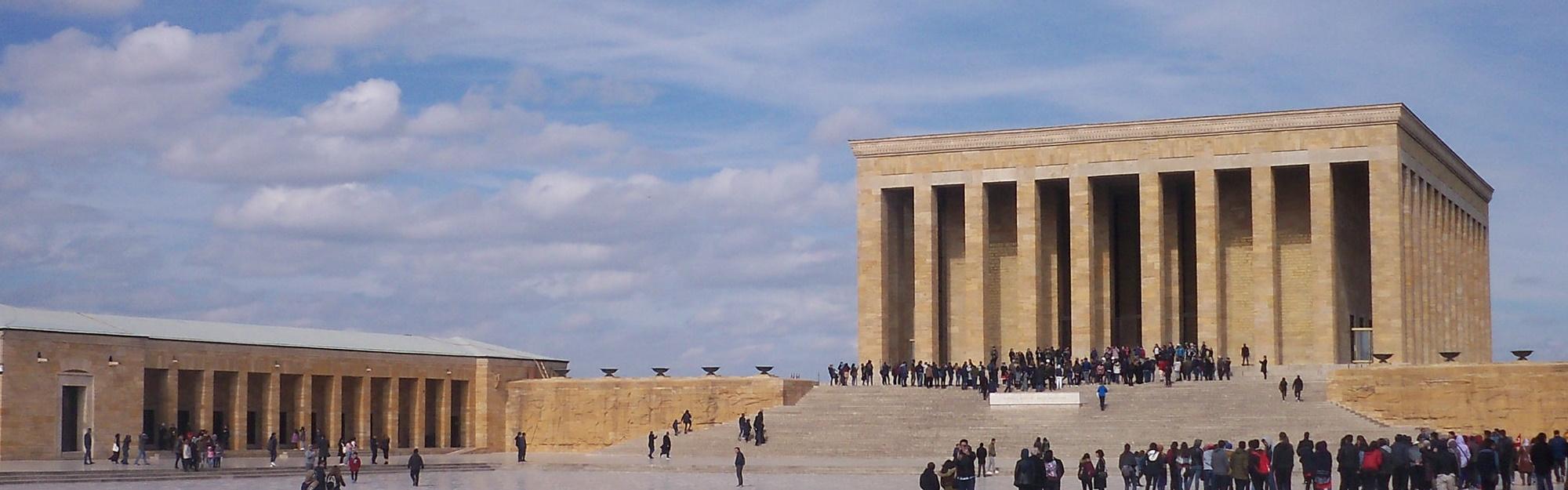
Anitkabir, a revered monument in Ankara, is accessed via a wide avenue lined with lion statues. This mausoleum is the final resting place of Mustafa Kemal Atatürk, the founder of the Turkish Republic. It attracts visitors from across Turkey, who come to honour their national hero. The site is also a fascinating attraction for tourists, with its imposing colonnaded structure leading to a spacious courtyard that houses a museum. Inside the main hall, the ceiling is adorned with stunning gold leaf mosaics, and throughout the site, there are numerous reliefs and statues to admire.
Museum of Anatolian Civilizations
The museum charts the history of Asia Minor and is housed in a lovely 15th-century restored building close to the centre of Ankara. Originally a market and caravanserai close to the centre of Ankara, it's the ideal place to visit for anyone intending to travel through Turkey and delve into the past. It's filled with fascinating collections of archaeological finds, from monolithic statues to delicate jewellery, including some from Catal Huyuk, believed to be the earliest known human social community in the world. From the Palaeolithic and Neolithic, and through all the great civilisations since, this museum is like a time machine for ancient history buffs.

The Ethnography Museum of Ankara
When the founder of the Turkish Republic, Ataturk, died in 1938, he was buried in the courtyard of the building that now houses the Ethnography Museum. Although he was moved to his final resting place at the imposing Mausoleum in Ankara, the museum is still well worth the visit. Guarded by an imposing bronze statue of the national hero astride his horse, it contains a vast collection of historical artefacts that include costumes, arts and crafts.
Natural History Museum
Anyone with an interest in the natural world will enjoy Ankara's Natural History Museum, which contains some fascinating exhibits and dioramas detailing the (often extinct) wildlife of Anatolia, as well as a large collection of fossils and minerals. Most interesting are the fossilized footprints of humans who walked the Anatolian steppes 25,000 years ago, and the skeleton of a Maras elephant, which lived in the area 193 million years ago.

Mount Ararat
Mount Ararat lies in the far east of Turkey and is home to the twin peaks of a dormant volcano, which also boast the highest summit in the country. According to legend, the remains of Noah's Ark are said to rest on its snow-capped slopes. While many tours offer the chance to climb or even ski the mountain, solo climbing without a guide or permit is not allowed. The ascent to the top is relatively straightforward, requiring only a basic level of fitness, making it suitable for non-professional climbers. For those who prefer not to climb, the local Kurdish villages at the foot of the mountain offer a rich cultural experience. Added to that, the nearby town of Dogubayazit not only provides stunning views of Ararat but also has the second-largest meteor crater in the world. Noah's Ark National Park, located on the mountain, houses a museum that features what are believed to be the fossilised remains of the ark.
Getting Around
Ankara offers a range of convenient and affordable public transport options for visitors exploring the city. The metro system has two main lines: the M1 runs from Batikent to Kızılay, and the Ankaray light rail connects AŞTİ (Intercity Bus Station) to Dikimevi. Both accept the Ankarakart, a smart card that also works for municipal buses (EGO), trams and even some private buses. The tram system is a great way to travel through central areas such as Kızılay.
For a more personalised ride, Uber operates in the city, offering a range of vehicles, while BiTaksi, a local rideshare app, connects passengers to traditional taxis. Visitors can also use Dolmuş minibuses, which run along fixed routes, or flag down metered taxis for short trips.
If visitors are heading to the airport, the Havaş shuttle provides direct service between Esenboğa Airport and key city locations. With various options, including bike-sharing programs such as Ankara Bisiklet, getting around Ankara is easy and efficient for tourists looking to explore the city's attractions.
Ankara Climate and Weather
Because of Ankara's elevation and inland location, the city has warm and dry summers, with cold and snowy winters. The rainy season is spring, especially May. Typical temperatures in summer range between 60ºF (16ºC) and 86ºF (30ºC) in summer, while the average temperatures winter range between 25ºF (-4ºC) and 44ºF (7ºC).
Turkey travel info
Electricity
The electrical current is 220 volts AC, 50Hz. The European two-pin plug is standard.
Language
Turkish is the official language, but English is widely understood in the main tourist areas.
Money
The official currency is the Turkish lira (TRY), which is divided into 100 kurus, and currency can be exchanged at banks, exchange booths, post offices, airports and ferry ports. Travellers should note that banks have the worst rates but will exchange lesser known foreign currencies. Banks open mainly Monday to Friday, but some are open daily in tourist areas. Major credit cards are widely accepted; Apple Pay and Google Pay are increasingly supported. Some hotels in the most popular destinations accept US dollars as payment.
Tipping
Tipping is appreciated in Turkey and it's often preferred that patrons leave service charges in cash rather than on a card. The customary amount is 10 to 15 percent of the bill, though guests at Turkish baths (hammams) typically leave between 10 and 20 percent of the total bill if service has been good. It's enough to round up the bill for taxi fares.
Health
Mosquitoes can be an irritation in mid-summer, but malaria isn't considered a significant risk in the main tourist areas of the west and south-west. However, there's a low risk in rural and southeastern areas, so travellers planning to visit those regions should consult with a healthcare provider. Most tap water in larger towns and cities is chlorinated and safe to drink, but bottled water is still recommended, especially in rural areas. Food from street vendors should be approached with caution unless it's clearly fresh or hot. The quality of healthcare in state hospitals may not meet high standards, but private hospitals in cities such as Ankara and Istanbul offer modern facilities and are well-regarded. In case of emergency, travellers should dial 112; travel insurance, including coverage for medical evacuation, is highly recommended.
Safety
Street crime in Turkey is generally low, but visitors should always remain vigilant and guard their valuables, especially in crowded tourist areas. It's advisable to avoid public demonstrations, as they can sometimes turn tense or unpredictable. Turkey lies along a major seismic fault line, so earthquakes and tremors are a real risk, particularly in the eastern and central regions. While the threat of terrorism exists, with past incidents occurring in places such as Istanbul, Ankara and popular coastal resorts, it remains a rare occurrence in tourist-heavy areas. However, caution is advised, especially in the southeast, where there are ongoing local security concerns related to regional terrorism. Staying updated on travel advisories and avoiding risky areas is recommended for a safer visit.
Local customs
While it's difficult to generalise about a country as diverse as Turkey, which stretches from Armenia to Greece, the Turkish people are typically welcoming and hospitable. Visitors to modern Istanbul or popular holiday resorts will often find locals to be open-minded, yet tourists should still be mindful of local customs, especially during the month of Ramadan. Although Turkey is a secular country, many people observe fasting during Ramadan, making it considerate to remain aware of this, particularly in more conservative areas. When visiting mosques or religious shrines, visitors should dress modestly (covering shoulders and legs) and women may be expected to cover their heads with a scarf in some places, with scarves often provided. Smoking is prohibited on public transportation and in many indoor public spaces, such as restaurants and cafes, but remains common in outdoor venues.
If invited to someone's home, it's customary to bring a small gift, though overly expensive gifts might create an unnecessary sense of obligation. Tea (çay) is a fundamental part of Turkish culture, frequently offered as a gesture of hospitality. Refusing tea may be considered impolite, so it's best to accept, even if only a small sip. Public displays of affection are generally frowned upon in more conservative or rural areas, meaning it's wise to be discreet. When greeting someone, a firm handshake is common, and in more familiar settings, a kiss on both cheeks is often exchanged. Being aware of these local customs will help ensure a respectful and enjoyable experience in Turkey.
Doing business
In Turkey, business associates are typically addressed by their first names. If the associate is male, his name is followed by 'Bey', and 'Hanım' is used for females. While English is often spoken in business settings, especially in larger cities or multinational companies, learning a few words in Turkish can help establish goodwill. A formal, conservative dress code is observed, and women should take particular care to dress modestly. It's important to note that while punctuality is valued in business meetings, there can sometimes be a more flexible approach to time in social settings. Business meetings often begin with some small talk before getting into the agenda, as building relationships is a key part of Turkish business culture. In meetings, it's also important to respect hierarchy, with the most senior person often leading the discussions. Gifts are common in Turkey, and they are usually practical items that can be used in business, such as pens or office stationery. Business cards should be exchanged with both hands, and it's courteous to have one side of the card translated into Turkish. Business hours in Turkey are generally from 9 am to 5 pm, Monday to Friday, with a one-hour lunch break, but it's always a good idea to be flexible with scheduling. Finally, if invited to someone's home or to a meal, it's considered respectful to accept the invitation, as Turkish people take hospitality seriously.
Duty free
Travellers to Turkey do not have to pay duty on the following items: 200 cigarettes, or 50 cigars, or 200g tobacco; 1 litre of alcohol over 22 percent volume or 2 litres under 22 percent volume; 120 ml of perfume or eau-de-cologne; and 1,5 km of (instant) coffee and 500g of tea.
Communications
The international country dialling code for Turkey is +90; internet connectivity is good, particularly in larger cities and tourist destinations.
Passport & Visa
Travel documents must be valid for at least 150 days when travellers arrive, and have at least one blank page. All visitors are required to hold return or onward tickets, documents for the next destination and sufficient funds for the period of their stay. It's highly recommended that travellers' passports have at least six months' validity remaining after the intended date of departure from their travel destination. Immigration officials often apply different rules to those stated by travel agents and official sources.
Entry requirements
US passport holders must have a passport that is valid for six months beyond their date of entry. Ordinary passport holders are exempted from the visa requirement for up to 90 days in any 180-day period.
UK passport holders must have a passport that is valid for six months beyond their date of entry. Ordinary passport holders are exempted from the visa requirement for up to 90 days in any 180-day period.
Canadian passport holders must have a passport that is valid for at least 60 days beyond the duration of their stay. Tourism visas are not required for stays of up to 90 days in a 180-day period.
Australian passport holders must have a passport that is valid for six months beyond their date of entry, and will need an e-visa for tourism or business if they're staying for less than 90 days in a 180-day period.
South African passports must be valid for at least six months from the intended date of arrival. South African nationals require a visa to enter Turkey.
Irish citizens require a passport with a minimum of 150 days' validity to enter Turkey. Visas are not required for stays of up to 90 days within any 180-day period for purposes such as tourism and business travel.
New Zealand citizens must have a passport that's valid for at least six months beyond the date of their departure. Visas are required for stays longer than 90 days.
Useful contacts
Ministry of Culture and Tourism: +90 (312) 470-80-00, alo176@ktb.gov.tr
112 (Police, Fire and Medical Emergencies)