

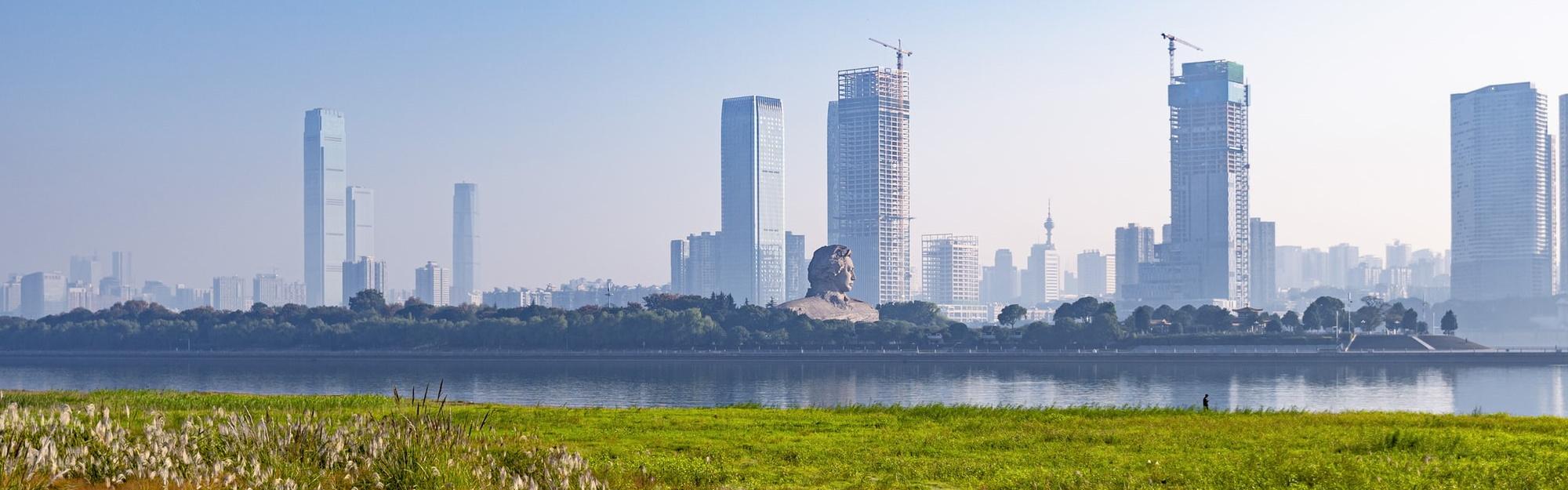

Changsha Travel Guide
Perched along the Xiang River, Changsha is the capital of Hunan Province (south central China). With a history spanning some 3,000 years, it is a cultural and historical treasure. Indeed, the iconic former leader of the country, Mao Zedong, was born in the village of Shaoshan, around 47 miles (77 km) outside the city. His hometown serves as a memorial for those who wish to pay their respects and learn more about China's recent past.
Some of its oldest landmarks include the Yuelu Academy on the slopes of Mount Yuelu. Built in 976, it's an institution of learning whose legacy rivals the ancient English universities of Oxford and Cambridge. It managed to survive under many dynasties, including the Song, Yuan, Ming and Qing. The academy is pretty much on the Orange Isle's doorstep. Visitors will have a difficult time choosing between the isle's faces, with beautiful orange trees blossoming in spring, and snowfall creating a delicate wonderland during winter.
The Mawangdui Han Tombs stand out among the city's many must-see attractions, and contain the mummified remains of a woman from the Western Han Dynasty. Added to this, the Hunan Provincial Museum has more than 110,000 artefacts, ranging from the Neolithic Age to the Qing Dynasty, as well as more objects from the tombs themselves.
Historical significance aside, Changsha is modern and vibrant, thanks largely to a rebuilding period after the Sino-Japanese War and a widespread fire in 1938. It's also known as a garden city, following the results of a green programme to better the environment and its dynamics with urban areas. Magnolias and blossoms spring up throughout the region. That said, the city still has a buzzing commercial district, with dozens of high rises and financial centres.
Regarding its cuisine, Hunan is known for mouth-numbingly hot and spicy flavours, even more so than Sichuan Province. Like any south Asian city, numerous markets sell fresh food, along with many street vendors and restaurants.
For visitors looking to relax in nature, the Mount Dawei National Forest Park offers clear waterfalls, running streams and mountaintop lakes. Huan Martyr's Park is another option, with the pleasant lake dedicated to those who passed away in the struggle to create the communist government. Thrill seekers, on the other hand, will love bungee jumping at the Window of the World.
Changsha has a rich past, being a landmark of both ancient and recent history. Aside from these sites of historical significance, it is also blessed with scenic outdoor attractions and a great and unique local food scene.
China travel info
Electricity
Electrical current is 220 volts, 50Hz. Plug types vary, but the two-pin flat blade and oblique three-pin flat blade plugs are common. Adapters are generally required.
Language
The official language is Mandarin Chinese, but there are hundreds of local dialects.
Money
China's currency is the Renminbi Yuan (CNY), which is divided into 10 jiao or 100 fen. Cashless payments via smartphone applications such as WeChat Pay are increasingly commonplace in main cities, and major credit cards are widely accepted. ATMs are widely available in major cities. It is not possible to exchange Scottish or Northern Irish bank notes; banks are closed on weekends.
Tipping
Tipping is not officially recognised in China, though the practice is has become increasingly common among tour guides, top-end restaurants, tour bus drivers and hotel staff. Travellers wanting to tip should leave a gratuity of about 10 percent. Large hotels and restaurants often include a service charge in their bills, usually of around 10 percent, so travellers should make sure that they aren't doubling up.
Health
A yellow fever vaccination certificate is required from travellers coming into China from infected where there is a risk of transmission. There is a risk of malaria throughout the low-lying areas of the country, and it is recommended that travellers to China seek medical advice about malaria before departure. All eligible travellers should be up to date with their COVID-19 vaccines; vaccinations are recommended against hepatitis A and hepatitis B, typhoid (not necessary if eating and drinking in major restaurants and hotels), Japanese encephalitis (usually only recommended for rural areas), and rabies (only recommended for travellers at risk of animal bites). Tap water shouldn't be drunk unless it has first been boiled, filtered or chemically disinfected. Street food should be treated with caution. High levels of air pollution in major cities and industrialised areas in China may exacerbate bronchial, sinus or asthma conditions. There is generally a high standard of health care in major Chinese cities, but it is not provided free of charge; travellers are advised to have comprehensive travel health insurance.
Safety
China is one of the safety countries to visit in Asia. Serious crime against foreigners is rare but does occur, particularly in isolated or sparsely populated areas. If travelling alone, including following parts of the Great Wall, it is advisable to leave an itinerary and expected time of return with a third party. Travellers should take extra care in street markets and at tourist sites, which attract thieves and pickpockets, and around the popular expat bar areas at night, where lone foreigners have occasionally been targetted. Travellers should be cautious about using pedicabs in Beijing, as tourists have reportedly been mugged by the drivers. Disputes over taxi fares can occur. Passengers should insist on paying the metered fare and should ask for a receipt; this has the taxi number on it.
Seasonal heavy rains and typhoons cause hundreds of deaths in China each year, particularly those areas bordering the Yangtze River in central, southern and western China. Demonstrations have taken place in Lhasa, Tibet, as well as in some Chinese provinces in protest against Chinese rule in Tibet. Even though the situation seems to have stabilised, visitors are advised to stay up to date on the situation before travelling to the region and to avoid all protests. The Chinese government sometimes suspends the issue of permits for travel to Tibet due to unrest.
There is currently little threat from global terrorism. The risk of terror attacks is higher in the Xinjiang Uyghur Autonomous Region and travellers should exercise caution if travelling to or around Xinjiang.
Local customs
Chinese people usually have three names, the first of which is their surname, or family name. As a result, visitors should be prepared for hotels mistakenly reserving rooms under their first names. For clarity, surnames may be underlined. When addressing Chinese people, the surname should come first and official titles should be used. Chinese handshakes last longer than those in western countries, and it is customary to stand close together when in conversation. Politeness in western terms is often foreign to the Chinese, and they rarely bother with pleasantries. It is considered disrespectful to keep prolonged eye contact, avoiding eye contact is considered reverential rather than rude. All foreigners should carry their ID on them at all times, as spot checks are common. Failure to show evidence of ID when requested by an official may result in a fine or detention.
Doing business
The Chinese are strict timekeepers and being late for a meeting is considered rude. When meeting people for the first time it is normal to shake hands and say 'ni hao', which means 'how are you'. Handshakes generally go on for longer in China than in most western countries. Business cards are commonly exchanged at the start of meetings in China; it is customary to have one side printed in Chinese and one in English. When giving or receiving business cards or a gift, it is customary to hold it with both hands. Chinese consider gifts an important show of courtesy. Decision-making may take longer than expected during negotiations. During a meal or reception, a host is likely to offer a toast; foreigners may be expected to offer them one in return.
Women are generally treated with respect and courtesy when doing business in China and it is increasingly common to find Chinese women in senior positions, especially in the big cities. Businesswomen should, however, avoid showing too much skin. Business dress for both men and women tends to be conservative and plain without much ornament or bright colour.
Business hours are 8am to 5pm, Monday to Saturday. A five-day week is more common in larger cities and international companies. Workers usually take their lunch break between 12pm and 2pm and it is not unusual to find offices empty during this time.
Duty free
Travellers to China do not need to pay customs duty on 400 cigarettes or 100 cigars or 500g of tobacco; 1.5 litres of alcohol; perfume for personal use; and personal articles up to the value of CNY2000. Prohibited goods include arms, ammunition, or printed material that conflicts with the public order or moral standards of the country. Also prohibited are radio transmitters and receivers, exposed but undeveloped film and fresh produce. Strict regulations apply to the import and export of antiquities, banned publications, and religious literature. All valuables must be declared on the forms provided.
Communications
The international dialling code for China is +86. Hotels, cafes and restaurants offering free WiFi are widely available. As international roaming costs can be high, purchasing a local prepaid SIM card can be a cheaper option.
Passport & Visa
There are a few complex exceptions to Chinese visa requirements, which will not apply to the majority of visitors, but all requirements should be confirmed with a Chinese embassy before travel. All documents necessary for further travel and sufficient funds to cover intended period of stay are required; travel to Tibet will require a special Tibet Entry Permit. It's recommended that passports be valid for six months after intended period of travel.
Entry requirements
US nationals require a passport that is valid for six months after the date of departure. A visa is required for entry into China.
UK nationals require a passport that is valid on arrival for six months after the date of departure. A visa is required for entry.
Canadians require a passport that is valid for six months at the time of entry. A visa is also required.
Australians require a passport valid on arrival, and a visa for entry to China. A valid visa is required.
South African nationals require a passport valid on arrival, and a visa for entry to China.
Irish nationals require a passport valid on arrival, and a visa for entry to China.
New Zealand nationals require a passport valid on arrival, and a visa for entry to China.
Useful contacts
Ministry of Culture and Tourism, Guangxi: +86 773 288 5326, www.topchinatravel.com/
110 (Police); 120 (Ambulance)