

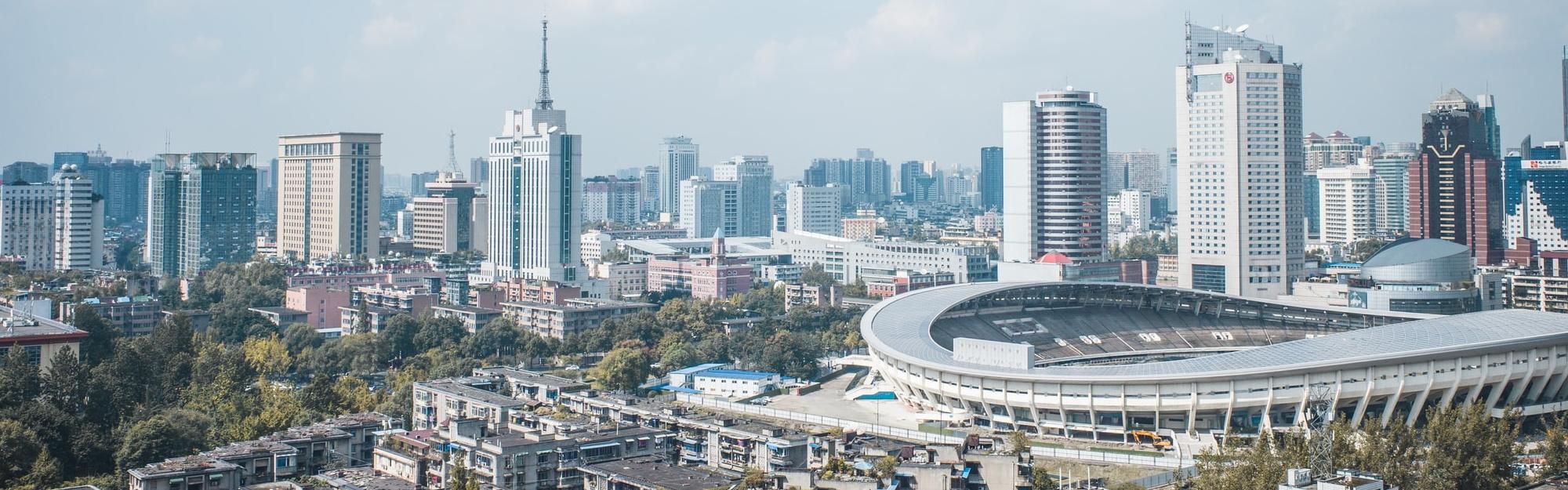

Chengdu Travel Guide
Located on the fertile plains of Sichuan Province's Red Basin, Chengdu seems so much like a small town that it's easy to forget it is one of China's largest cities. With nicknames such as 'Heavenly State', 'City of Hibiscus' and 'Land of Milk and Honey', it is no wonder that Chengdu is also ranked as one of China's most liveable places.
Still a well-kept secret for many tourists, Chengdu lacks the famous historical sites that draw crowds to tourist magnets such as Beijing, Shanghai and Xi'an. This doesn't mean that the city lacks historical importance, being the site of origin for the Bronze culture, the Southern Silk Road and the printing of the first paper currency. Chengdu is full of rich history, where travellers can visit attractions such as the Wenshu Monastery, Wuhou Memorial Temple, Tomb of Wang Jian, Green Ram Temple and the Thatched Cottage of the ancient poet Du Fu.
Chengdu is an important culinary destination in China, and visitors can attend traditional Chinese tea ceremonies at many teahouses, including Wenshu Monastery and Guanghe Chalou. The food in Chengdu is some of the best in the region, offering fiery Sichuan dishes such as hotpots, Chongqing duck neck and spicy dragon prawns from roadside carts or stylish restaurants.
But the top attraction in Chengdu is located in the lush valleys surrounding the town: the Chengdu Panda Breeding and Research Center is the world's only centre of its kind, and offers one-of-a-kind opportunities to see and interact with pandas and their cubs.
Chengdu makes a great base for exploring the Sichuan Province, as it is within easy distance of the Giant Buddha of Leshan, Mount Qingcheng and the Jiuzhaigou Scenic Area. It is also a convenient stopover on travels to Tibet, as there are almost daily flights to Lhasa.
Things to do in Chengdu
Situated in the centre of Chengdu Plain, at the confluence of the Min and Tuo Rivers, is the maze-like city of Chengdu. Travellers are most commonly drawn to the area by the Chengdu Panda Breeding and Research Centre, but once there they discover many other interesting things to see and do.
Pandas are justifiably Chengdu's biggest attraction, and the Chengdu Panda Breeding and Research Centre has popularised conservation of these gentle giants. The centre rehabilitates and breeds a number of animals besides the loveable Giant Pandas, including Red Pandas, South China Tigers, and Golden Monkeys. It is an absolute must for anybody who loves animals and is interested in wildlife conservation. For a special donation, visitors can even hold a panda cub.
Another popular excursion from Chengdu is a trip to Mount Qincheng just outside the city. The mountain provides wonderful hiking opportunities amidst many historical and cultural places of interest.
Travellers interested in archaeology and ancient civilisations should visit the Jinsha Site Museum, located on the site where archaeologists unearthed an ancient village of the Shu Kingdom (220 to 280 AD) and displays some wonderful ancient relics and artefacts. A good companion site in town is the Wuhou Memorial Temple, which has shrines to the ministers of the Shu Kingdom.
Other attractions in Chengdu include Wenshu Temple, the city's largest Buddhist temple complex, and People's Park, a big public park with a number of attractions, including a rather odd underground museum. Kuanzhai Ancient Street is also worth visiting, as it's a trendy shopping street and cultural hot spot as well as a historic preservation area with several ancient structures. Kuanzhai and the charming Jinli Alley are the best places for bargain hunting and sampling local cuisine.

Chengdu Panda Breeding and Research Center
The Chengdu Panda Breeding and Research Centre is a must see for animal lovers. The largest centre of its kind, Chengdu was founded with the aim of increasing the population of giant pandas in captivity so that more may be released into the wild. The park is also a home to other endangered Chinese animals, such as the South China Tiger, red pandas and golden monkeys. It takes about two hours to walk the grounds; alternatively, visitors can ride in a tour cart. It is best to go for feeding time (9am to 10am), which is when the animals are most active.
Mount Qincheng
Mount Qingcheng is said to be the birthplace of Taoism, and serves as a popular destination for locals and tourists alike. It's two sides provide rather different experiences. The front of the mountain is more tourist friendly, boasting an impressive array of cultural and historical landmarks such as the Jianfu Palace, Tianshi Cave and Shangqing Palace. The back of the mountain is more off the beaten track, and there are stunning but demanding hiking routes through narrow and unspoilt passes, waterfalls and woods. Although the paths are well maintained, there is a cable car that can be taken halfway or all the way up. The mountain is an ideal escape from crowded urban sightseeing and is a must for those interested in the region's flora and fauna.

Kuanzhai Ancient Street
Kuanzhai Ancient Street is one of three historic preservation areas in the city and scores highly on most visitors' lists of things to see and do in Chengdu. It is formed by the confluence of three alleys: Kuan Alley, Zhai Alley and Jing Alley. The city once boasted 45 18th-century courtyards, and Kuanzhai contains the only three that remain well-preserved. Kuanzhai is trendy and artistic and an entertaining cultural experience for visitors, with ancient Chinese architecture providing a captivating contrast to modern restaurants and art galleries. It is particularly interesting to walk this street in the evening when the ancient attractions are juxtaposed with a lively nightlife, bright city lights and cultural dance performances.
Getting Around
Public transport in Chengdu is mostly comprised of an extensive bus network, and there is a free shuttle service that links all parts of the city centre. The other option is the metro, which connects the North and South Railway Stations. Trains are regular and safe, if a little crowded during rush hour. Metered taxis are available, though difficult to find in some areas; travellers shoud note that it is necessary to have their destination written in Chinese, as most drivers don't speak English. Didi is the city's most popular ride-hailing app. Hiring a car in Chengdu is not advised due to heavy and chaotic traffic, especially at rush hour times.
Chengdu Climate and Weather
Chengdu has a humid subtropical climate, with four distinct seasons. Spring is short and warm, summer is long, wet, and steamy, autumn is cool and rainy, and winter is cold and foggy; average minimum and maximum temperatures range from 28F (-2C) in the winter (December to February) up to 86F (30C) at the peak of summer (June to August). Chengdu is humid and foggy for most of the year, which reduces sunlight hours and can exaggerate the feel of the temperature. The rainy season is in July and August, when occasional storms are experienced. The best time to visit is in the spring and autumn, March to June and September to November.
China travel info
Electricity
Electrical current is 220 volts, 50Hz. Plug types vary, but the two-pin flat blade and oblique three-pin flat blade plugs are common. Adapters are generally required.
Language
The official language is Mandarin Chinese, but there are hundreds of local dialects.
Money
China's currency is the Renminbi Yuan (CNY), which is divided into 10 jiao or 100 fen. Cashless payments via smartphone applications such as WeChat Pay are increasingly commonplace in main cities, and major credit cards are widely accepted. ATMs are widely available in major cities. It is not possible to exchange Scottish or Northern Irish bank notes; banks are closed on weekends.
Tipping
Tipping is not officially recognised in China, though the practice is has become increasingly common among tour guides, top-end restaurants, tour bus drivers and hotel staff. Travellers wanting to tip should leave a gratuity of about 10 percent. Large hotels and restaurants often include a service charge in their bills, usually of around 10 percent, so travellers should make sure that they aren't doubling up.
Health
A yellow fever vaccination certificate is required from travellers coming into China from infected where there is a risk of transmission. There is a risk of malaria throughout the low-lying areas of the country, and it is recommended that travellers to China seek medical advice about malaria before departure. All eligible travellers should be up to date with their COVID-19 vaccines; vaccinations are recommended against hepatitis A and hepatitis B, typhoid (not necessary if eating and drinking in major restaurants and hotels), Japanese encephalitis (usually only recommended for rural areas), and rabies (only recommended for travellers at risk of animal bites). Tap water shouldn't be drunk unless it has first been boiled, filtered or chemically disinfected. Street food should be treated with caution. High levels of air pollution in major cities and industrialised areas in China may exacerbate bronchial, sinus or asthma conditions. There is generally a high standard of health care in major Chinese cities, but it is not provided free of charge; travellers are advised to have comprehensive travel health insurance.
Safety
China is one of the safety countries to visit in Asia. Serious crime against foreigners is rare but does occur, particularly in isolated or sparsely populated areas. If travelling alone, including following parts of the Great Wall, it is advisable to leave an itinerary and expected time of return with a third party. Travellers should take extra care in street markets and at tourist sites, which attract thieves and pickpockets, and around the popular expat bar areas at night, where lone foreigners have occasionally been targetted. Travellers should be cautious about using pedicabs in Beijing, as tourists have reportedly been mugged by the drivers. Disputes over taxi fares can occur. Passengers should insist on paying the metered fare and should ask for a receipt; this has the taxi number on it.
Seasonal heavy rains and typhoons cause hundreds of deaths in China each year, particularly those areas bordering the Yangtze River in central, southern and western China. Demonstrations have taken place in Lhasa, Tibet, as well as in some Chinese provinces in protest against Chinese rule in Tibet. Even though the situation seems to have stabilised, visitors are advised to stay up to date on the situation before travelling to the region and to avoid all protests. The Chinese government sometimes suspends the issue of permits for travel to Tibet due to unrest.
There is currently little threat from global terrorism. The risk of terror attacks is higher in the Xinjiang Uyghur Autonomous Region and travellers should exercise caution if travelling to or around Xinjiang.
Local customs
Chinese people usually have three names, the first of which is their surname, or family name. As a result, visitors should be prepared for hotels mistakenly reserving rooms under their first names. For clarity, surnames may be underlined. When addressing Chinese people, the surname should come first and official titles should be used. Chinese handshakes last longer than those in western countries, and it is customary to stand close together when in conversation. Politeness in western terms is often foreign to the Chinese, and they rarely bother with pleasantries. It is considered disrespectful to keep prolonged eye contact, avoiding eye contact is considered reverential rather than rude. All foreigners should carry their ID on them at all times, as spot checks are common. Failure to show evidence of ID when requested by an official may result in a fine or detention.
Doing business
The Chinese are strict timekeepers and being late for a meeting is considered rude. When meeting people for the first time it is normal to shake hands and say 'ni hao', which means 'how are you'. Handshakes generally go on for longer in China than in most western countries. Business cards are commonly exchanged at the start of meetings in China; it is customary to have one side printed in Chinese and one in English. When giving or receiving business cards or a gift, it is customary to hold it with both hands. Chinese consider gifts an important show of courtesy. Decision-making may take longer than expected during negotiations. During a meal or reception, a host is likely to offer a toast; foreigners may be expected to offer them one in return.
Women are generally treated with respect and courtesy when doing business in China and it is increasingly common to find Chinese women in senior positions, especially in the big cities. Businesswomen should, however, avoid showing too much skin. Business dress for both men and women tends to be conservative and plain without much ornament or bright colour.
Business hours are 8am to 5pm, Monday to Saturday. A five-day week is more common in larger cities and international companies. Workers usually take their lunch break between 12pm and 2pm and it is not unusual to find offices empty during this time.
Duty free
Travellers to China do not need to pay customs duty on 400 cigarettes or 100 cigars or 500g of tobacco; 1.5 litres of alcohol; perfume for personal use; and personal articles up to the value of CNY2000. Prohibited goods include arms, ammunition, or printed material that conflicts with the public order or moral standards of the country. Also prohibited are radio transmitters and receivers, exposed but undeveloped film and fresh produce. Strict regulations apply to the import and export of antiquities, banned publications, and religious literature. All valuables must be declared on the forms provided.
Communications
The international dialling code for China is +86. Hotels, cafes and restaurants offering free WiFi are widely available. As international roaming costs can be high, purchasing a local prepaid SIM card can be a cheaper option.
Passport & Visa
There are a few complex exceptions to Chinese visa requirements, which will not apply to the majority of visitors, but all requirements should be confirmed with a Chinese embassy before travel. All documents necessary for further travel and sufficient funds to cover intended period of stay are required; travel to Tibet will require a special Tibet Entry Permit. It's recommended that passports be valid for six months after intended period of travel.
Entry requirements
US nationals require a passport that is valid for six months after the date of departure. A visa is required for entry into China.
UK nationals require a passport that is valid on arrival for six months after the date of departure. A visa is required for entry.
Canadians require a passport that is valid for six months at the time of entry. A visa is also required.
Australians require a passport valid on arrival, and a visa for entry to China. A valid visa is required.
South African nationals require a passport valid on arrival, and a visa for entry to China.
Irish nationals require a passport valid on arrival, and a visa for entry to China.
New Zealand nationals require a passport valid on arrival, and a visa for entry to China.
Useful contacts
Ministry of Culture and Tourism, Guangxi: +86 773 288 5326, www.topchinatravel.com/
110 (Police); 120 (Ambulance)