


Luxembourg-Ville Travel Guide
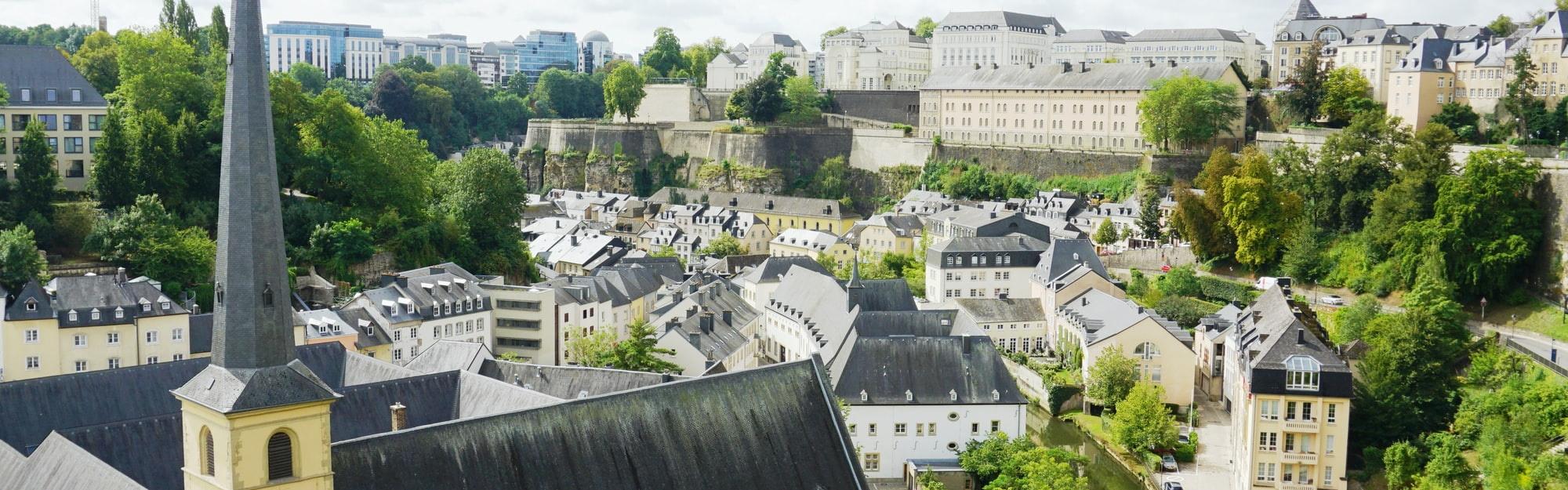
In the early morning mist, Luxembourg is reminiscent of an ancient fairytale city, full of towers and turrets. The old centre of town, declared a UNESCO World Heritage Site, can trace its history back to the 10th century, when the Count of the Ardennes built a castle on a rock above the Alzette River.
He named the castle Lucilinburhuc. Over the centuries, the castle and surrounding town was strengthened with numerous additional fortifications, walls and gates until it became known as the 'Gibraltar of the North'. Today, the various components of the fortress are the city's chief tourist attractions, with the old town centre containing several museums.
Modern Luxembourg, on the Plateau du Kirchberg, is more concerned with business than pleasure, as the work of a major international financial centre goes on inside the many modern office complexes in the city.
Luxembourg is chock full of banks and home to numerous European Union institutions. The European Council of Ministers holds their sessions in the city for three months every year, and the European Court of Justice presides here too.
Although tourists come to the city to enjoy the medieval charm and history, the financial prestige attracts businessmen and the modern buzz of the place ensures there are good restaurants and lots of quality hotels. Luxembourg is a tiny country but still offers many wonderful excursions to the surrounding towns and countryside.
Things to do in Luxembourg-Ville
Luxembourg-Ville, or Luxembourg City as it is often called, has a UNESCO-listed Old Town and a fairytale, medieval charm which draws visitors. The main attractions in Luxembourg include the remains of the Bock Fortress, particularly the subterranean casements, the Grand Ducal Palace, the Philharmonie Luxembourg, which offers a wonderful selection of concerts and performances, the National Museum for History and Art, and the Passerelle or Luxembourg Viaduct, a bridge built in 1861 which affords incredible views of the city. The smallness of the country is an advantage for travellers because almost all places of interest to sightseers are within reach from the capital, allowing for a variety of fun excursions. It takes no more than a quick drive or train trip to reach any number of picturesque ancient villages nestled among Luxembourg's lovely countryside. Some of the most popular daytrip destinations are Clervaux, Echternach, Mondorf-Les-Bains, Vianden, Remich and Grevenmacher. Another well-known attraction near the city is the American Cemetery and Memorial which commemorates the soldiers killed during World War II and is a moving site.
The best time to visit the city, and indeed the rest of the country, is in the sunny, comparatively warm months between May and August (spring and summer), as Luxembourg-Ville can get a bit bleak and cold during winter.
The Fortress
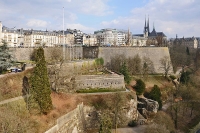
The mighty fortress established by Count Siegfried atop the Rock of Bock in 963 eventually became a citadel with three girdles of fortified battlements. As the centuries passed, the stone cliff foundations underneath the castle were excavated to form a network of 14 miles (23km) of underground tunnels, housing arsenals, kitchens and slaughter-houses. In 1867, the Treaty of London declared it would be demolished after centuries of sieges and battles. Despite this, several sections of the fortress still remain and the subterranean casements are open for viewing. The best way to view the remaining parts of the fortifications is on foot, strolling through the cobbled streets of the old town.Although the casements officially open in March, they sometimes open later in the year without any warning.
Grand Ducal Palace
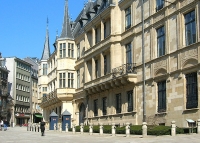
The city residence of the Grand Ducal family is right in the heart of the old town, restrained yet remaining aesthetically pleasing with its Italian Renaissance facade. Built of ochre stones, it overlooks a paved pedestrian square and features spires and railings. Originally the site of a medieval town hall destroyed by a gunpowder explosion in 1554, those with an eye for architecture can tell the palace was built over various periods, with much of the structure dating back to the 16th century. Guided tours are usually available in the peak summer months, by arrangement with the Luxembourg City Tourist Office. But for the majority of the year, visitors can't explore the castle.
The National Museum for History and Art
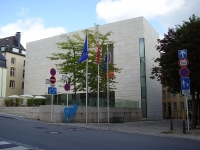
The National Museum for History and Art contains major archaeological finds, such as artefacts from the Gallo-Roman period and the Middle Ages. The vast collection covers the history of Luxembourg since the first evidence of human habitation, with exhibitions on fine and modern art, medieval artefacts and old weapons. It also includes exhibits on local culture and folklore, and interesting photographs demonstrating how the city has changed through the decades. The museum regularly hosts workshops and temporary exhibitions covering a wide range of topics.
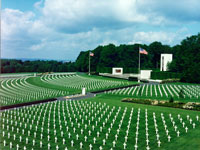
Luxembourg American Cemetery and Memorial
In a silent forest clearing near the village of Hamm lie the graves of more than 5,000 American soldiers killed during World War II, when it was a battleground on the Western Front. There is a striking memorial, maps detailing Allied progress through Europe and lists commemorating those who went missing during the war and were never found. The cemetery has become a pilgrimage, its lines of white crosses a sobering and moving sight. Unlike many, the Luxembourg American Cemetery closes each day at 5pm. Not far away at the village of Sandwieler, a German cemetery of some 10,000 soldiers gives more of a sense of the horror and futility of war.
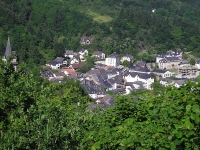
Vianden
The picturesque village of Vianden is situated on the banks of the Our River and guarded by a magnificent medieval castle, making for a pleasant day trip only 25 miles (40km) north of Luxembourg City. The castle dates back to the 9th century and was originally the home of the counts of Vianden, powerful nobles until the 13th century. It houses a museum that captures life in the Middle Ages and recounts the area's troubled history. In the small town below, visitors can sip tangy Moselle wines beside the stream while enjoying the views of the green hills. Strolling along the narrow cobbled streets beneath towers and medieval ramparts feels like stepping back through time. The surroundings of the town are magnificent, providing many pretty walking trails. Indian Forest Adventure Park also offers thrilling zip-line courses for the whole family, allowing visitors to traverse the forest canopies.
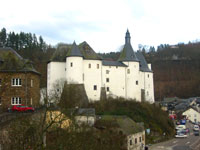
Clervaux
A 12th-century castle overlooks the village of Clervaux, located in the heart of the Ardennes Mountain region 30 miles (50km) north of Luxembourg City. A Romanesque church with twin spires and a large Benedictine monastery completes this idyllic setting. The castle houses three small museums, including one that features a collection of World War II memorabilia from the Battle of the Bulge while another room is dedicated to the Luxembourg Holocaust victims. Benedictine monks also sometimes hold Gregorian chant concerts at the 1910 St Maurice Abbey. The town is picturesque and has numerous appealing restaurants and cafes, as well as a charming shopping district and hotels. Clervaux is easily accessible by train and is a popular excursion from the capital.
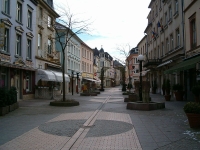
Echternach
The beautiful old town of Echternach lies on the border between Germany and Luxembourg on the banks of the Sûre River. It boasts a famed abbey founded in the 7th-century by St Willibrord, whose remains are contained in a magnificent white marble sarcophagus in the crypt of the Basilica. There are three museums, one dedicated to the history of the abbey, another showcasing ancient artefacts and a third detailing rural architecture. Echternach also boasts the remains of an ancient Roman villa, thought to have been the largest of its kind north of the Alps. Echternach also attracts visitors because of its stunning natural surroundings. It serves as a base for hikers and nature lovers wishing to explore the Mullerthal, a fascinating landscape of sandstone formations, waterfalls, creeks, springs and forests. Also known as 'Little Switzerland', it's criss-crossed with hiking trails and dotted with picturesque villages.
Moselle Valley
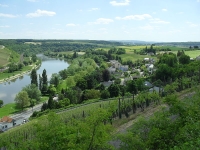
The Moselle Valley has been a wine-growing region since the 19th century, now developed as an important tourist industry thanks to its rural atmosphere and idyllic environment. Along the riverbanks of the Moselle River, a tributary of the Rhine, are vineyards that produce a wine which connoisseurs rate as among the best in Europe. A wine tour through the quiet villages and wine cellars of the region proves a scenic and relaxing experience. The principal town of Grevenmacher is old with narrow streets, the remains of medieval fortifications and a 13th-century belfry. The town's claim to fame is the wine cellars of Caves Bernard-Massard, housing internationally-acclaimed sparkling wines. There is a small museum in the town, and an exotic butterfly garden.
Mondorf-les-Bains
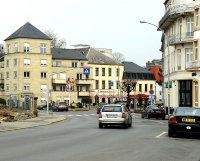
Thousands come on holiday to Mondorf-les-Bains to enjoy the verdant surroundings and thermal springs of one of the most modern balneotherapy centres in Europe. Found in the Moselle region, the town is very old, established by the Celts and conquered by the Romans in about 65 BC. The holiday resort consists of a thermal park set in 50 hectares of parkland, offering a variety of sports facilities, saunas and swimming pools, as well as waterfalls, whirlpools and geysers. The hot springs are said to be particularly good for the treatment of liver, gastric and respiratory ailments, with visitors also pampered by massages and mud baths. Historical and architectural attractions include interesting frescoed churches, a Roman fortress and Art Nouveau-style houses, pairing well with its casino, luxury accommodation, great shopping opportunities and excellent restaurants.
Getting Around
Luxembourg is a tiny country and it's possible to get essentially anywhere in less than an hour. Bus services are excellent within Luxembourg City and most routes pass through the central bus station, making it easy to get to most places. A standard ticket is €2 while a day pass is €4. The buses also travel out to villages like Junglinster, Mersch, Trier and Wasserbillig.
Bus tickets are valid on the comprehensive train network, connecting to destinations in Germany and Belgium. Renting a car in Luxembourg is also an option as local drivers are polite and the road system is well-developed. Parking can be difficult to find on weekends in Luxembourg City.
Luxembourg-Ville Climate and Weather
Nestling behind the barrier of the Ardennes Mountains, Luxembourg City is protected from the cold North Sea winds and enjoys a temperate maritime climate. Summers are mild and pleasant, and winters cool to cold. The warmest months of the year are between May and September, but even at the height of summer Luxembourg City is seldom hot, with temperatures averaging 74°F (24°C). Visitors in the summer should anticipate a noticeable drop in temperature at night.
In winter (November to February), temperatures average 32°F (0°C), with more extreme weather in the northern reaches of the country, which also receive more rain. Spring (March to May) is a beautiful season as the mountains and valleys come alive with wild flowers.
The best time of year to visit Luxembourg City is in the spring and summer, between May and September, when the weather is pleasant and outdoor activities are plentiful and popular. Tourists generally avoid its sometimes frigid winter, but the country does have some lovely Christmas markets over December.
Luxembourg travel info
Electricity
The standard voltage is 230 volts, 50Hz. European-style two-pin plugs are used.
Language
The official languages in Luxembourg are Luxembourgish, which is a Germanic language with German roots and French influences, as well as French and German. English is widely spoken.
Money
The currency in Luxembourg is the euro (EUR), which is divided into 100 cents. Foreign currency can be exchanged at all Luxembourg banks and bureaux de change, as well as the airport and post office. Major hotels will also exchange currency, though rates are high. Major credit cards are widely accepted; mobile payment systems such as Google Pay and Apple Pay are supported.
Tipping
Hotel and restaurant bills generally include a service charge in Luxembourg. Porters and doormen in upmarket hotels appreciate small tips and taxi drivers expect a tip of around 10 percent.
Health
No vaccination certificates are required for entry to Luxembourg and there are no health risks associated with travel to the country. Medical facilities are of a high standard in cities but may be limited outside of urban areas.
Travellers should get a European Health Insurance Card (EHIC) before visiting, or a Global Health Insurance Card (GHIC) if they're UK residents, so that they're covered for necessary state healthcare while there. Dental care and repatriation costs aren't included in this, so it's a smart move to get travel insurance as well.
If travellers require certain medication during their trip, it's best to bring it in its original packaging with a signed and dated letter from a doctor detailing what the medication is and why it's needed.
Safety
Travel to and around Luxembourg is very safe and the country has low crime rates. Visitors should take normal precautions against pick-pockets and petty theft, but trips are likely to be trouble free.
Local customs
Luxembourg is a proud and stable country, with a culture surprisingly closed off to foreign influences and marked by formal social interactions. European visitors will find Luxembourg's social environment to be very similar to that of France or Germany, although perhaps slightly more conservative.
Visitors should avoid putting their feet up on tables or chairs, or pointing their finger when referring to someone as this is rude. Body language is quite muted in Luxembourg and it's considered impolite to inquire about a stranger's private affairs.
Doing business
French is the language of business in Luxembourg, though some German and English is also used. Translators are readily available but some effort at speaking French will be appreciated. Business exchanges are quite formal, beginning with a handshake and an exchange of business cards.
Punctuality is essential and dress is formal, with a suit and tie the norm. Surnames and titles are usually used. Luxembourgers are polite and cautious, and it's important to build personal relationships. Business hours are usually 8.30am to 5.30pm Monday to Friday, often closing for an hour at lunch.
Duty free
Travellers over 17 years arriving from non-EU countries do not have to pay duty on 200 cigarettes or 100 cigarillos or 50 cigars or 250g tobacco, or a proportional mix of these; 1 litre spirits with alcohol content higher than 22 percent, 2 litres of spirits with alcohol content below 22 percent, 4 litres of wine, 16 litres of beer or a proportional mix of these. Other goods allowed include gift items and souvenirs to the value of €430 per adult travelling by sea or air, €300 per adult travelling overland, and €175 for children below 15 years.
Communications
The country code for Luxembourg is +352. Travellers can purchase local prepaid SIM cards for unlocked phones or use eSIMs if their cellular providers support it on their networks. Free WiFi is widely available at hotels, cafes and restaurants in tourist areas.
Passport & Visa
The borderless region known as the Schengen Area includes the following countries: Austria, Belgium, Czech Republic, Denmark, Estonia, Finland, France, Germany, Greece, Hungary, Iceland, Italy, Latvia, Lithuania, Luxembourg, Malta, The Netherlands, Norway, Poland, Portugal, Slovakia, Slovenia, Spain, Sweden and Switzerland. All these countries issue a standard Schengen visa that has a multiple entry option, and which allows the holder to travel freely within the borders of all the aforementioned countries. Additionally, passengers not having visible means of support, and those who are suspected of being a danger to public security, tranquillity or order may be refused entry to Luxembourg. Moreover, it's advised that non-EEA passengers hold return or onward tickets, and the necessary travel documentation for their next destination, as refusal of entry upon arrival can lead to serious difficulties and costs for passengers and transporting airlines.
It's highly recommended that travellers' passport have at least six months' validity remaining after the intended date of departure from their travel destination. Immigration officials often apply different rules to those stated by travel agents and official sources.
Entry requirements
US citizens must have a passport that is valid for at least three months beyond the period of intended stay in Luxembourg. No visa is required for stays of up to 90 days within a 180 day period.
UK citizens must have a passport that is valid for at least three months beyond the period of intended stay in Luxembourg. No visa is required for stays of up to 90 days within a 180 day period.
Canadian citizens must have a passport that is valid for at least three months beyond the period of intended stay in Luxembourg. No visa is required for stays of up to 90 days within a 180 day period.
Australian citizens must have a passport that is valid for at least three months beyond the period of intended stay in Luxembourg. No visa is required for stays of up to 90 days within a 180 day period.
South African citizens must have a passport that is valid for at least three months beyond the period of intended stay in Luxembourg. A visa is required.
Irish citizens must have a passport that is valid upon their arrival in Luxembourg. No visa is required.
New Zealand citizens must have a passport that is valid for at least three months beyond the period of intended stay in Luxembourg. No visa is required for stays of up to 90 days within a 180 day period.
Useful contacts
Luxembourg Tourism Website: www.ont.lu
113 (Police) and 112 (Emergency service)