

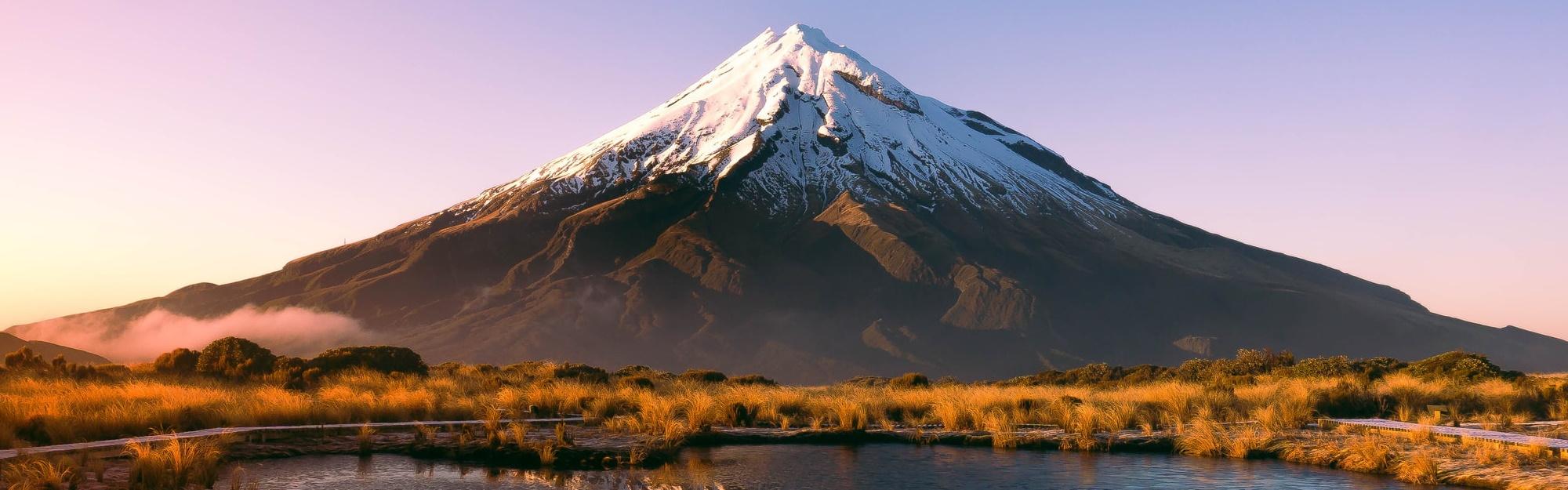

North Island Travel Guide
The North Island has many superb physical features, and it's home to New Zealand's two major cities, Auckland, the 'City of Sails' and the capital, Wellington. It offers island-studded bays and sailing, volcanic activity and geothermal wonders, wild rugged coastlines, and fascinating Maori culture and history.
The beautiful region in the far north is known as Northland and includes the picturesque Coromandel Peninsula, which reaches into the sea between Auckland and the Bay of Plenty. It has magnificent kauri forests of enormous 3,000-year-old trees, stunning coastal scenery, beaches and scenic bays, quaint seaside townships, and mountain ranges. The Bay of Islands is the most popular destination and has opportunities for sailing, diving, snorkelling, and kayaking on the clear blue waters around the islands. The top of the island tails off into a rugged desolate finger of land with sand dunes and the long white sandy stretch of Ninety Mile Beach along its west coast.
At the heart of the North Island is the Central Plateau, which is the centre of the country's volcanic activity. Volcanoes, bubbling mud pools, hot springs, spouting geysers, steaming lakes and rivers are strewn across the landscape. Rotorua, the Maori cultural heartland, sits at the edge of the most concentrated area of activity and is characterised by the unmistakable smell of sulphur. Lake Taupo, formed by one of the greatest eruptions ever recorded, has beautiful views across to the volcanic peaks of Tongariro National Park, with excellent hiking, and is regarded as the trout fishing capital of the world.
At the southern tip of the island lies New Zealand's capital, Wellington, a beautiful city in a striking setting around a harbour and surrounded by mountains. It's the centre of the country and a major travel crossroads between the North and South Islands.
Things to do in North Island
Other than the attractions of the two main cities, Auckland and Wellington, there is plenty to and see on New Zealand's North Island. As the heartland of the Maori people, the North Island is rich in history and culture, with sites such as Rotorua and Wai-O-Tapu especially significant in local history. A mixture of unique culture and strange natural phenomenon make these places extremely interesting. Rotorua, for example, has the most thermal activity in New Zealand through its hot springs and thermal baths. It draws crowds from all over the world to enjoy this natural spa treatment. Similarly, Wai-O-Tapu is a natural spectacle of thermal activity that boasts spectacular colour schemes in its pools of warm water, which have been active for over 100,000 years.
On the very northern tip of the island, known as Northland, towards the warm waters of Polynesia, lies the ancestral home of New Zealand's first inhabitants. Here visitors can enjoy the beautiful beaches along the coast and join in the locals love for watersports of all kinds, including surfing, diving and skiing. For those who want to learn more about the native people of the North Island, it's worth visiting Mitai Maori village, which offers a genuine introduction to an indigenous cultural experience in a sacred and spiritual place.
A popular way to see a large part of the island is to embark on a driving tour around the North Island. One common suggestion is to start the self-driving New Zealand tour in Auckland and complete a loop including many key areas such as Rotorua, Napier, Wellington, Taupo, Whakatane, Waiheke, Kaitaia and Gisborne, so as to experience a good variety of what the island has to offer.
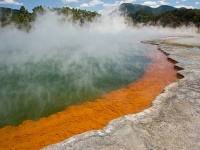
Wai-O-Tapu Thermal Reserve
Wai-O-Tapu, meaning 'Sacred Waters', is a diverse and colourful geothermal sightseeing experience. The area has been active for more than 100,000 years and features thick pools of boiling mud that bubble and belch, geysers, sulphuric mineral terraces, and steaming pools that create a kaleidoscope of colour. Walkways around the area allow visitors to admire the display of some of the most incredible earth forces in the world. Some of the best features include the spectacular Champagne Pool, a large steaming and bubbling pool fringed by red and yellow ochre deposits, and the evil looking Devil's Bath, where the high concentration of arsenic creates the vivid green colour of the water.
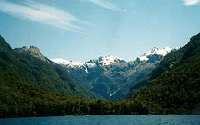
Taranaki
Located between Wellington and Auckland, Taranaki has for a long time been largely overlooked by tourists in New Zealand. It's only recently that visitors have discovered the charms of the westernmost province in New Zealand, with its lush gardens, rolling hills of dairy farms, scenic parks, and world-class surf spots. The biggest city in Taranaki is New Plymouth, a busy port on the Tasman Sea rated by the United Nations as one of the best small cities in the world.
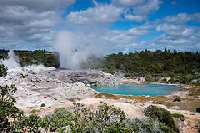
Rotorua
Rotorua lies on the Volcanic Plateau of Central North Island, and continuous volcanic activity has formed its landscape. The destination's main attractions are based around its natural resources, with there being a number of hot springs and thermal baths that are the basis for its fast-growing fame as 'Nature's Spa of the South Pacific'. Crystal lakes offer holiday activities such as trout fishing and water sports, and nearby geothermal fields feature bubbling mud pools, spouting geysers, and steaming rivers. Rotorua is also the Maori cultural heartland and visitors can experience the spirit of their culture in many performances featuring stories relayed through song and dance, and a 'hangi' feast, the traditional Maori method of cooking in an earthen pit.
New Zealand travel info
Electricity
The electrical current is 230 volts, 50Hz. Oblique flat blade plugs are standard.
Language
The official languages in New Zealand are English, Maori and New Zealand Sign Language.
Money
The local currency is the New Zealand dollar (NZD), which is divided into 100 cents. Most businesses accept MasterCard and Visa and, while Diners Club and American Express are also widely accepted in the main tourist centres, they might have limited acceptance elsewhere. ATMs can be found in all towns and cities.
Tipping
Gratuities are not expected in New Zealand, but it's acceptable for guests to tip at their discretion.
Health
There are no health risks associated with travel to New Zealand. New Zealand's Accident Compensation Commission (ACC) covers emergency treatment for visitors, but health insurance is recommended to cover any additional charges and for those not entitled to free emergency treatment. Those intending to participate in adventure activities, such as bungee jumping, white water rafting should ensure that their travel insurance covers these types of activities.
Safety
New Zealand has a reputation as one of the safest destinations in the world, but sensible precautions against petty theft are still advised. Among them, travellers should avoid leaving possessions in unattended vehicles, even if they're out of sight, and they should use the hotel safe if possible.
Travellers who plan on swimming in coastal waters should be aware that riptides are common and can be dangerous, and that several drownings are reported every year. Sharks, seals and other wildlife present a risk to swimmers in certain areas. Travellers should avoid unsupervised beaches and at all times follow the instructions and warnings of lifeguards.
Adventure tourism, which includes zip-lining, rock climbing or trekking, can be dangerous, especially if activities are not well-organised. Enthusiasts should educate themselves on best practices for safety, and arrange activities through a tour operator that meets international standards.
Local customs
Though New Zealand has a strong reputation for tolerance towards homosexuality, there are still isolated incidents of homophobic related crime. LGBT travellers should be aware of local sensitivities, especially when visiting rural areas. Importing illegal drugs is punishable by up to 12 years' imprisonment.
Doing business
New Zealand is ranked first in the World Bank's Ease of Doing Business rankings. The business culture of New Zealand conforms to a typically British model: formal, reserved and conservative. However, this is tempered with a characteristically Antipodean warmth and friendliness, creating a relaxed, yet professional atmosphere.
Business etiquette in New Zealand will be familiar to those who've worked in western corporate environments before. Foreigners should use titles until instructed not to do so, and maintain eye contact when speaking to their associates. Business meetings should be scheduled at least a week in advance, and then confirmed a few days before they are due to take place. The dress code for business in New Zealand is usually formal. For meetings, men should stick to a dark suit, worn with a tie; women should wear a smart dress, business suit or pants suit, and limited accessories.
The official language of business in New Zealand is English, and business hours are generally from 8.30am (or 9am) to 5pm, Monday to Friday; and 9am to 12.30pm on Saturdays.
Duty free
Travellers to New Zealand over 18 years do not have to pay duty on 50 cigarettes, or 50g of cigars or tobacco, or a mixture of all three not exceeding 50g; three bottles of spirits or liqueur each containing not more than 1,125ml; 4.5 litres of wine or beer; and other goods to the value of NZD 700. Goods exceeding the allowances must be declared. Personal effects not dutiable include items such as jewellery, binoculars, portable radios, prams, camping equipment, cameras and video cameras. Prohibited items include concealed firearms, foodstuffs, animals, plants and plant products. It is forbidden to export Greenstone, Maori antiquities and Paua shells (unless they are products manufactured from such shells). Prescription medications need to be accompanied by a doctor's letter and the original prescription, they should not amount to more than three months worth of the medication.
Communications
The international access code for New Zealand is +64. The outgoing code is 00 followed by the relevant country code (e.g. 0061 for Australia). A good option is to purchase a local prepaid SIM card at the airport on arrival. Alternatively travellers use eSIMs if their cellular providers support it on their networks. WiFi access is widely available in hotels, restaurants and other tourist establishments, except in some of the more remote areas.
Passport & Visa
All foreign passengers to New Zealand must hold return or onward tickets, the necessary travel documentation for their next destination, and proof of sufficient funds to cover their expenses while in the country (usually NZD 1,000 per month, or NZD 400 if accommodation has been prepaid). All visitors must obtain a permit to enter Tokelau from the Tokelau Apia Liaison Office in Apia, at least two weeks prior to travel. It's highly recommended that travellers' passports have at least six months' validity remaining after the intended date of departure from their travel destination. Immigration officials often apply different rules to those stated by travel agents and official sources.
Entry requirements
US citizens must have a passport that is valid for at least three months beyond the date of departure from New Zealand. No visa is required for stays of up to three months. Travellers must have a New Zealand Electronic Travel Authority (NZeTA) obtained prior to boarding.
UK citizens must have a passport that is valid for at least three months beyond their date of departure from New Zealand. No visa is required for stays of up to six months. Travellers must have a New Zealand Electronic Travel Authority (NZeTA) obtained prior to boarding.
Canadian citizens must have a passport that is valid for at least three months beyond the date of departure from New Zealand. No visa is required for stays of up to three months. Canadians must have a New Zealand Electronic Travel Authority (NZeTA) obtained prior to boarding.
Australian citizens must have a passport that is valid upon their arrival in New Zealand. No visa is required. An NZeTA is not required.
South African citizens must have a passport that is valid for at least three months beyond the period of intended stay in New Zealand. South Africans require a visitor visa that must be organised prior to travel.
Irish citizens must have a passport that is valid for at least three months beyond the period of intended stay in New Zealand. No visa is required for stays of up to three months. They must have a New Zealand Electronic Travel Authority (NZeTA) obtained prior to boarding.
Useful contacts
Tourism New Zealand, Wellington:+64 4 462 8000 or www.tourismnewzealand.com
111 (All Emergencies)