


Rhodes Travel Guide
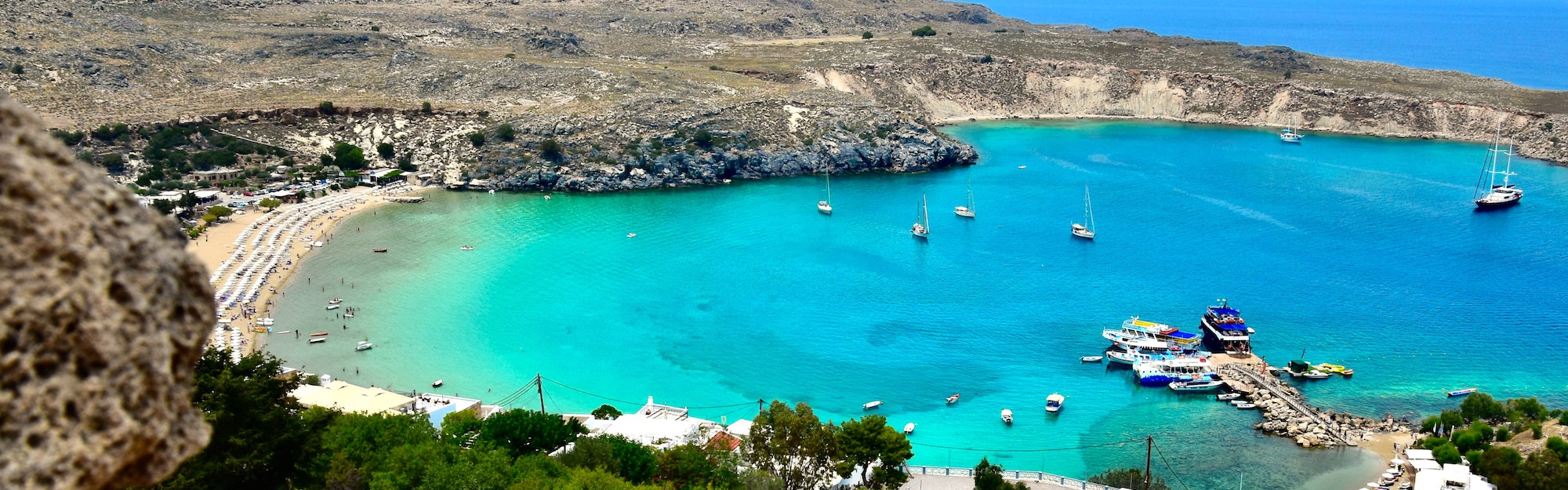
Knights once used Rhodes to protect the Christian west from the east. Today, the island remains subject to invasion, though from tourists rather than intruders. Said to be Greece's sunniest island, Rhodes has a well-preserved and picturesque old city. The legendary Colossus of Rhodes, one of the Seven Wonders of the World, guarded its harbour in antiquity; present-day visitors will find statues of deer. Nevertheless, the old city has plenty of wonders to offer. The rest of the relatively large island offers miles of beaches, interesting archaeological sites and natural beauty spots. The best beaches are on the east coast, and Lindos is especially attractive. Faliraki, on the other hand, is a developed resort area, bustling with young visitors.
Things to do in Rhodes
While Rhodes' most popular 'modern' attractions are its beautiful beaches, this island's rich past has laden it with a wealth of cultural and religious sites. Visitors can wander Old Town's charming streets and experience an old-world way of life. Or, they can climb Filerimos Hill to visit the medieval ruins. There are interesting castles at Kastellos and Monolithos, and the 200 BC Acropolis of Rhodes is another must-see. Beach lovers can sun themselves at a number of terrific shorelines, scuba dive or surf; options include Rhodes Town, Lindos, Faliraki, Tsambika and Ixia. There are also smaller and quieter beaches at Ladiko and Afandou. Children usually enjoy Rhodes' beaches and other attractions such as the Valley of the Butterflies, the local aquarium and the Faliraki Water Park.
Acropolis of Rhodes
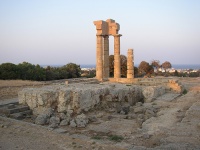
The ancient Acropolis of Rhodes sits high on a hill overlooking the city's west. In the past, it featured sanctuaries, large temples and public buildings, all set on stepped terraces interspersed with gardens. Today's remains date back to the 2nd century BC, though excavations continue at the site. The Stadium, however, has been fully excavated and restored, as has the Temple of Athena Polias on the site's northern edge. Visitors can also see the Nymphaia, a marble Odeon, the Temple of Pythian Apollo and the remains of the Gymnasium. In their day, these sites were used for recreation, worship, lectures and musical events. This hugely atmospheric site is worth visiting; views from the top are tremendous.
Karpathos
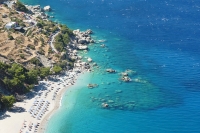
From Rhodes it's a short ferry crossing to the untouched island of Karpathos, where the clock has stood still in the delightful village of Olymbos in the south. Here the locals go about their business much as they did in Homer's time, wearing their traditional costumes and preserving their language and culture, partly with the aim of attracting tourists but also because they are proud of their heritage and want to preserve local customs. They are particularly proud of their unique houses, built of carved stone and decorated inside with gorgeous embroidery and other colourful folk art decor.
The island has great beaches and unspoilt villages and is a pleasure to explore, with a picturesque bay and a monastery at Kyra Panagia, the Diafani village on a promontory to the north, and forested mountains. Karpathos is also renowned for its feast days and weddings. Visitors who happen to catch one in progress will usually receive a warm invitation to join the festivities. Just four nautical miles from Karpathos is the smaller island of Kassos, linked by ferry, which has a tiny community of fishermen still living the way they have for centuries.
Filerimos Hill
Filerimos Hill used to be the citadel of the ancient town of Ialysos, and its large plateau is home to some intriguing historical attractions. On the eastern side of the hill, visitors can see the foundations of the Athena Polias temple and an early Christian basilica, dedicated to Virgin Mary, as well as a Byzantine church.
The Monastery of Filerimos, which is thought to have been built by knights, and was later renovated by Italians, is an important archaeological site where Mycenaean pottery and a Doric foundation have been unearthed. A lovely path to the west, lined with cypress and pine trees, leads to an impressive crucifix at the centre of a small square.
Apart from all the exciting archaeological ruins and artefacts, this is a pretty area that offers visitors lovely views from the vantage of the hill, and some great photo opportunities. Despite its wealth of ancient artefacts and historical significance, Filerimos Hill isn't as crowded with tourists as some of the other sites on Rhodes.
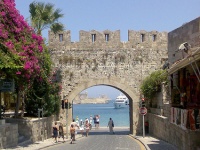
Rhodes Old Town
With buildings and monuments dating back hundreds of years, Old Town offers a wealth of historic attractions and has been declared a UNESCO World Heritage Site. The medieval streets feature Gothic windows and paved courtyards lit by traditional street lamps. The most famous of these is the Street of Knights (or Knights Avenue), which leads to the Palace of the Prince Grand Master. This palace displays several artefacts from as far back as the 13th century, when the crusades first came to Rhodes.
The shops and stalls of Socrates Street are worth browsing for local jewellery, pottery and clothes. Although there are many gates through which to enter the Old Town, one of the best starting points is Eleftheria (Liberty) Gate, from where visitors will come to Simi Square, which contains the ruins of the Temple of Aphrodite, thought to date from the 3rd century BC.
Getting lost in Rhodes Old Town is almost obligatory as there are about 200 streets that don't have names, so it can get confusing. Getting lost here is rather wonderful but when visitors need to find their way again, they should ask for Socrates Street, which is the 'main' street of the area. The Old Town is completely pedestrianised.
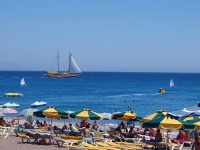
Rhodes Beaches
The beaches on Rhodes Island are a great attraction for visitors. There are about 45 attractive beaches on the island so there is a lot for visitors to choose from! Afandou beach is quite undeveloped and therefore good for those who don't like a crowd. Faliraki beach, on the other hand, is usually quite crowded and has all the necessary amenities including sunbeds, umbrellas, watersport facilities, restaurants and beach bars to enjoy. The shallow waters of Faliraki beach make it a popular holiday spot for families with children, as do the great facilities. The Faliraki Waterpark and Luna Park distinguish this beach from others on the island as they feature water slides, kamikaze slides and a gigantic wave pool, as well as fully trained and certified lifeguards for safety. Faliraki Beach is on the northeast of the island, just over seven miles (12km) from Rhodes town. Kalathos beach has crystal-clear waters, wooden sunbeds and bamboo umbrellas (very eco-friendly!) and Kallithea beach is renowned for its hot medicinal springs and beautiful palm trees. Lindos beach is right beneath the castle of the same name and is a peaceful little cove, great for a quick dip after visiting the castle.
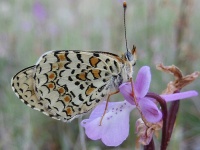
Petaloudes Valley of the Butterflies
The Petaloudes Valley of the Butterflies is a wonderful place to take the kids while on Rhodes, though any nature-lover will enjoy this unique experience. This attraction sees a myriad of beautiful butterflies colouring its skies and kids can follow them along the narrow streams, and over the rustic little bridges. The shaded walkways lead to rock pools and waterfalls, and carry a vanilla scent emanating from the local storax trees.
The best time to visit the valley is after the rainy season (which ends in late May) when the high humidity in the area sees thousands of Jersey Tiger Moths, which are in fact butterflies despite their name, cover the landscape. They are attracted by the Oriental Sweet Gum trees in the area and can be found in the valley throughout the summer.
The Valley of Butterflies is a natural park and a protected conservation area that's lovely to visit, even when the butterflies are not around.
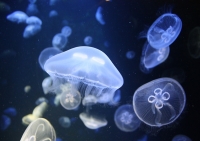
Marine Aquarium
Children love the Marine Aquarium on Rhodes Island, and will be enamoured by its diverse range of live Eastern Mediterranean specimens, which include sea flowers, turtles, octopuses and strange-looking decapods (crustaceans with 10 limbs). This venue has been used as an aquarium-museum and research station since 1963 and, as such, it displays an interesting collection of preserved and mounted marine specimens, as well as numerous scientific instruments.
The aquarium is housed in an interesting Art Deco building that was designed by an Italian architect when the island was under Italian rule. It's officially known as the Hydrobiological Station of Rhodes and is far more than a museum; the station is a research centre and a rescue and rehabilitation centre for aquatic animals that works to re-release animals back into the wild once they have been sufficiently cared for and rested.
The Marine Aquarium is a very well-respected institution, though it isn't as big as many modern aquariums. The aquarium creates an underwater atmosphere that captivates visitors of all ages and the air conditioning ensures it's a cool and refreshing place to be, especially on a hot summer day.
Shopping
Shoppers can choose from a vast selection of jewellery, ceramics, carpets and leather goods, as well as local wine, honey and olive oil. Old Town offers the best shopping on the island, with its outlets selling modern, classic and antique reproduction jewellery, as well as leather goods on Socrates Street. Shoppers can also purchase antique carpets, paintings and porcelain. Many shops close between November and March, when tourists are scarce.
Regarding the village scene, visitors will find local thimati honey in Siana and Vathi, and hand-woven carpets in Lindos, Afandou and Archangelos, and in some monasteries. Lace and embroidery are available in various shops throughout the island. Souvenir hunters should visit the Archaeological Museum of Rhodes, which sells reproductions of ancient statues, friezes, tiles and vases. Rhodes Town outlets offer local wines, Greek olive oil, some uniquely-styled shoes, plus the usual book stores and clothing retailers. Numerous gift shops near the main beaches sell cheap souvenirs, T-shirts and beachwear.
Nightlife
Rhodes is one of the liveliest islands in Greece. Its varied nightlife comprises bouzouki clubs, Greek folk dance nights and dance clubs; the streets off Faliraki beach are home to many popular cafes, bars and clubs, and there's a casino next to Elli Beach. Old Town also has a number of good entertainment venues, such as the Alexis Taverna, which hosted Winston Churchill and Jackie Kennedy once upon a time. The Son et Lumiere (Sound and Light) show at Palace of the Grand Masters is excellent.
Rhodes offers a variety of night-time diversions, ranging from the cultural to the purely hedonistic. Visitors often find an atmospheric restaurant and enjoy a long, drawn-out supper, preferably with a lovely view and some locals around them. Many of the bigger hotels have their own restaurants, bars and entertainment programmes, and all the big resorts offer entertainment options.
Getting Around
Rhodes is a major port with sea links to Athens, the islands of the Aegean and Crete, as well as to international destinations such as Turkey, Cyprus and Israel. Most international and inter-island ferries dock at Rhodes Town's commercial harbour, where travellers will find high-speed catamarans, hydrofoils, car ferries or flights to other islands in the Dodecanese. Rhodes receives direct flights from some airports in the UK during summer, and it's easy to catch a connecting flight from Athens. Public buses service the coastal towns around the island, while bus tours cover island excursions. Shared taxis are available for shorter distances, though Rhodes taxi drivers have a bad reputation for overcharging or receiving payoffs from hotels. Visitors should always agree on a fare before setting off. Rental car agencies are readily available all over the island. Horses, donkeys and bicycles are fun ways to explore the more rural and scenic areas, and walking is also a good option in many parts of Rhodes.
Rhodes Climate and Weather
The Rhodes climate ensures hot, dry weather in summer and mild winters. Temperatures in peak tourist season (July and August) range from 82ºF (28ºC) during the day to 72ºF (22ºC) at night, which is a bit cooler than some other Greek islands. Rainfall is almost non-existent in summer, though showers can be expected between October and March. Despite the heat being oppressive by some standards, summer remains the most popular time to visit. The summer months of June, July and August see the island packed full of tourists, with prices escalating accordingly; spring and autumn may be the best times to visit. Late spring is particularly lovely, as it has most of the benefits of summer and fewer disadvantages. That is, the sea is getting warm, there are fewer people, and Rhodes is particularly lush. Early autumn visitors will find balmy water, fewer tourists than in summer, and an island that's warm without being swelteringly hot.
Greece travel info
Electricity
Electrical current is 230 volts and 50Hz. A variety of plugs are in use, including the European-style two-pin and the round three-pin.
Language
Greek is the national language, but English is widely spoken.
Money
The official currency is the euro (EUR), which is divided into 100 cents. All major credit cards are accepted and ATMs are widespread; mobile payment systems such as Google Pay and Apple Pay are supported.
Tipping
A service charge is automatically added to most restaurant bills and an additional tip is not expected, though it's always welcome. Rounding up the bill is sufficient for drinks at cafes; taxis, porters and cloakroom attendants will expect a tip.
Health
Most health problems come from too much sun and too much food or alcohol, though there's also the risk of encountering sea urchins, jellyfish and mosquitoes. Medical facilities in major cities are excellent but some of the smaller islands are a long way from a decent hospital. Larger towns and resorts have English-speaking private doctors and the highly professional local pharmacies can usually deal with any minor complaint. Travellers should take along any necessary prescription medication in the original container, which should have a prescription label. The name on the prescription must match the name on the traveller's passport. Food and water are safe, but those visiting for short periods should consider sticking to bottled water. After Brexit, the Global Health Insurance Card (GHIC) replaced the European Health Insurance Card (EHIC) for UK citizens. The GHIC allows UK citizens access to state healthcare during visits to the EU. The GHIC is not valid in Norway, Iceland, Liechtenstein or Switzerland, nor is it an alternative to travel insurance.
Safety
Though Greece is a safe destination, peak tourist season usually sees a spike in petty theft cases, especially in crowded areas. Visitors should conceal valuables or store them in hotel safes and watch out for pickpockets. Violent crime is rare but there have been incidents on some islands; visitors travelling alone should not accept lifts from strangers.
Demonstrations take place regularly, particularly in Athens around Syntagma Square, Omonia Square and Exarchia, and Thessaloniki around Aristotelous Square, Egnatia Street, the Arch of Galerius and the campus of Aristotle University. These protests draw large groups of people and often take place with little notice. They can disrupt public transport and roads; protesters and police might also clash. Sometimes petrol bombs and fireworks are thrown by protesters, and police deploy tear gas. Protests are usually held on days of social or historical significance, such as Workers' Day on 1 May, the commemoration of the Athens Polytechnic uprising of 1973 on 17 November, and the commemoration of the riots of 2008 on 6 December. Violent clashes can occur between supporters of rival football teams during which Molotov cocktails and stones have been thrown, and people have been killed. Travellers should avoid areas where demonstrations and large gatherings are taking place, follow the instructions of local authorities, and monitor local media for information on ongoing demonstrations. Transport and tour operators don't always follow safety and maintenance standards. Travellers should always check if their travel insurance policy covers the pursuit in question, ask about and insist on minimum safety requirements, and always use available safety gear, such as life jackets or seatbelts. If proper safety equipment isn't available, they should use another provider. There's a high risk of wildfires during the summer season from April to October, and visitors should be cautious if they're in or near an area affected by wildfires. If travellers find themselves in these sorts of situations, they should follow the guidance of the emergency services, or call the Greek emergency services on 112 if they're in immediate danger.
Local customs
Most Greeks are more traditional than the British in some ways, but they're also friendly and welcoming enough to seem intrusive to reserved British tourists. Greeks are the heaviest smokers in Europe and will often ignore the smoking ban in public places. Swimwear is expected on the beach but tourists should dress properly in bars and restaurants.
Doing business
Greeks prefer to dress formally in dark-coloured suits for men and stylish outfits for women. Punctuality is important to them, though meetings may not start immediately. Visitors should offer a firm handshake and maintain eye contact when greeting Greek men and women for the first time, and print business cards in both Greek and English. There's no ritual surrounding the exchange of business cards.
As Greeks like getting to know their colleagues before conducting any serious business, it's unlikely a deal will take shape at the first meeting. The local culture follows a hierarchical structure and visitors should show respect in the same way. Gift giving is common in social settings but not necessarily in business.
Duty free
Travellers visiting from inside the EU can bring in 800 cigarettes, or 200 cigars, or 400 cigarillos, or 1kg of tobacco, 10 litres of spirits with an alcohol volume over 22 percent, 20 litres of spirits with an alcohol volume under 22 percent, 90 litres of wine and 110 litres of beer.
Visitors arriving from outside the EU and are over the age of 17 will not pay duty for 200 cigarettes, or 50 cigars, or 100 cigarillos, or 250g of tobacco, 1 litres of spirits with an alcohol volume over 22 percent, 2 litres of spirits with an alcohol volume under 22 percent, 4 litres of wine and 16 litres of beer.
Communications
The international access code for Greece is +30 and the outgoing code is 00, followed by the relevant country code (e.g. 0044 for the United Kingdom). Free WiFi is available at cafes, hotels, restaurants and similar establishments throughout Greece; travellers can purchase local prepaid SIM cards for unlocked phones or use eSIMs if their cellular providers support it on their networks.
Passport & Visa
The borderless region known as the Schengen Area includes the following countries: Austria, Belgium, Czech Republic, Denmark, Estonia, Finland, France, Germany, Greece, Hungary, Iceland, Italy, Latvia, Lithuania, Luxembourg, Malta, The Netherlands, Norway, Poland, Portugal, Slovakia, Slovenia, Spain, Sweden, and Switzerland. All of these countries issue a standard Schengen visa that has a multiple entry option, and which allows the holder to travel freely within the borders of all the aforementioned countries.
Non-EEA travellers to Greece must hold visible means of financial support to cover their stay in the country. It's also recommended that non-EEA members hold return or onward tickets, and the necessary travel documentation for their next destination. Passengers not holding onward tickets may be asked for proof of sufficient funds for their return or onward journey. It's highly recommended that travellers' passports have at least six months' validity remaining after the intended date of departure from their travel destination. Immigration officials often apply different rules to those stated by travel agents and official sources.
Entry requirements
US citizens must have a passport that is valid for six months beyond the period of intended stay. No visa is required for a touristic stay of up to 90 days within a 180 day period.
UK citizens must have a passport that is valid for six months beyond the period of intended stay. No visa is required for a touristic stay of up to 90 days within a 180 day period.
Canadian citizens must have a passport that is valid for at least three months beyond the period of intended stay in Greece. No visa is required for a touristic stay of up to 90 days within a 180 day period.
Australian citizens must have a passport that is valid for at least six months beyond the period of intended stay in Greece. No visa is required for a touristic stay of up to 90 days within a 180 day period.
South African citizens must have a passport that is valid for at least three months beyond the period of intended stay, and a valid Schengen visa, to enter Greece.
Irish citizens must have a passport that is valid on arrival in Greece. No visa is required.
New Zealand citizens must have a passport that is valid for at least three months beyond the period of intended stay in Greece. No visa is required for a touristic stay of up to 90 days within a 180 day period.
Useful contacts
Greek National Tourism Organisation, Athens: www.visitgreece.gr
112 (general European emergency number); 171 (tourist police)