

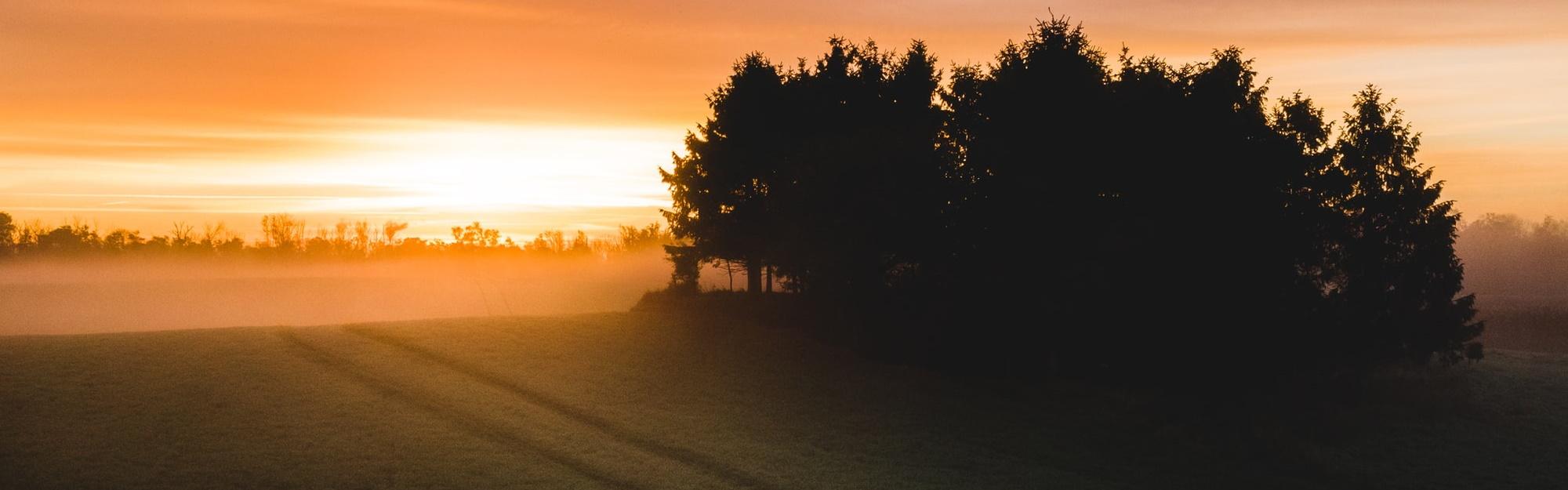

Roskilde Travel Guide
Roskilde may be only 22 miles (35km) from Copenhagen, but this small city has an ancient feel all of its own. It dates back more than a thousand years and was the capital of Denmark in medieval times, as well as a hub of both Viking activity and the Danish church.
The most significant attractions are the Roskilde Cathedral, which is the burial site for Danish monarchs, and the Viking Ship Museum, which displays ancient weapons, ships and other artefacts from the Viking Age.
The city is home to the Roskilde Palace, which is a former royal residence and now contains an art museum. The town is widely known as the home of the Roskilde Festival, one of Europe's biggest and most popular music festivals.
Roskilde is a small and pleasant town, small enough to get around on foot. It contains a number of museums and galleries worth visiting, as well as parks, cafes, pubs and shops. Roskilde has a pedestrian street running down the centre of the city where there's a number of great places to eat, drink and shop, as well as a number of tourist attractions. The university ensures a lively atmosphere, and the city of 52,000 is anything but sleepy.
Things to do in Roskilde
Roskilde is popular for both its ancient atmosphere and its lively young population, with visitors finding plenty of historical and modern attractions. Probably the most famous attraction in Roskilde is the UNESCO-listed Roskilde Cathedral, the burial site for Danish royalty.
Other great favourites include the Viking Ship Museum, with its enthralling collection of Viking artefacts and fun boat-building and sailing activities, and the Roskilde Museum, which has an interesting variety of displays detailing the city's long history.
For a more hands-on experience of Danish history, try a visit to the Lejre Research Centre. It's an interactive outdoor museum featuring reconstructions of living conditions from various eras of Roskilde's past. Built in 1733, Roskilde Palace is also definitely worth a visit: it is a striking yellow Baroque mansion which now houses the Roskilde Museum of Contemporary Art and the Palace Collections.
There is a pedestrian street running down the centre of Roskilde providing a good starting point for exploration of the city, crammed with restaurants, bars and shops. The city benefits from being conveniently close to Copenhagen, giving visitors easy access to all the wonders of the capital city too.
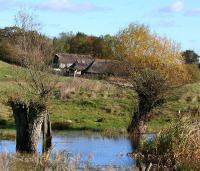
Lejre Research Centre
Also known as the Land of Legends, the Lejre Research Centre is one of the most popular attractions in Roskilde. The centre is a 106 acre (43 hectare) archaeological open-air museum situated just outside the city. It consists of amazingly lifelike reconstructions of an Iron Age village and sacrificial bog (200 BC to 200 AD), a Viking marketplace (900 AD), a Stone Age campsite (5,000 BC) and 19th century farm cottages. The Lejre Research Centre is high on the list of things to see and do with kids in Roskilde, as there are so many fun and educational activities.
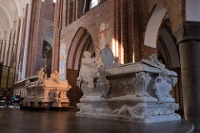
Roskilde Cathedral
The Roskilde Cathedral was the first Gothic cathedral built out of brick during the 12th and 13th centuries, and has been the burial site for Danish monarchs since the 15th century. A UNESCO World Heritage Site, the cathedral's twin spires dominate the Roskilde skyline, and the ornately gilded interior gives visitors a sense of the royal history of Denmark. Visitors are asked to be respectful of the fact that the cathedral is an active church, meaning it will sometimes be closed to tourists during ceremonies and services. There is a Cathedral Museum in the Great Hall of the Chapel of the Magi, containing illustrations and artefacts detailing the history of the cathedral from the early Middle Ages to the present day.
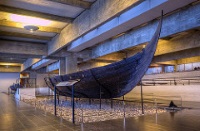
Viking Ship Museum
The Viking Ship Museum is home to five Viking ships dating back to the 11th century. Deliberately sunk in the channel to prevent an attack on the city around 1070, they were excavated in 1962. The ships range from cargo vessels to war raiders, and are displayed in the museum overlooking Roskilde Fjord replete with weapons and other artefacts. Visitors can also watch shipwrights at work and see examples of traditional Nordic wooden boats. There are lots of reconstructed Viking boats in the museum harbour and visitors can take a ride in some of them with a guide. According to tourist votes, the museum is generally the top-rated attraction in Roskilde.
Denmark travel info
Electricity
Electrical current is 230 volts, 50Hz. Round European-style, two-pin plugs are standard.
Language
Danish is the official language, but English is understood and widely used.
Money
Danish currency is the krone (DKK), made up of 100 ore. ATMs are easily found throughout the country, and all major credit cards are widely accepted, especially Visa. Most banks are not open on weekends but Copenhagen has several bureaux de change that stay open late at night, seven days a week.
Tipping
Those working in Denmark's service industry generally receive good wages. Service charges are usually included in bills so tipping isn't common. However, small tips are appreciated by bellhops, valets, maids, porters, or taxi drivers if guests feel the service has been good. Usually rounding up to the nearest kroner is acceptable.
Health
There are no specific health risks in Denmark and medical facilities are first class. No vaccinations are required, though eligible travellers should be up to date with their COVID-19 vaccines; free emergency treatment is available to all foreign visitors at public hospitals. After Brexit, the Global Health Insurance Card (GHIC) replaced the European Health Insurance Card (EHIC) for UK citizens. The GHIC allows UK citizens access to state healthcare during visits to the EU. The GHIC is not valid in Norway, Iceland, Liechtenstein or Switzerland, nor is it an alternative to travel insurance.
Safety
Most visits to Denmark are trouble free and crime levels are low, but tourists should be wary of opportunistic muggers, pickpockets and bag snatchers, especially in crowded areas, train stations and bus stops. Visitors should take precautions to keep personal belongings safe.
Local customs
Denmark is an egalitarian society. Women and men are treated equally.
Doing business
Business in Denmark tends to be conducted in a straightforward manner, though somewhat less formally than in some other parts of Europe. Greetings are made with a handshake, introductions are usually made using one's first name and it's normal to greet women first.
Punctuality is vital and, if running even five minutes late, it's important to call and apologise. Danes tend to be open-minded and friendly, and one can expect some small talk at the start of a meeting on a range of topics. Business cards are exchanged before or after the meeting.
Dress should be smart and neat, without being ostentatious, and English is widely spoken and understood. Business hours are usually 9am to 5pm, Monday to Friday. In the summer months (June to August), some Danes are on holiday, so it's best to check before arranging a business trip.
Duty free
Residents of non-EU countries entering from outside the EU are allowed 200 cigarettes or 100 cigarillos or 50 cigars or 250 grams of tobacco, as well as 1 litre of spirits, 4 litres of wine and 16 litres of beer.
Communications
The international country code for Denmark is +45. visitors can purchase local prepaid SIM cards for unlocked phones; public WiFi is widespread.
Passport & Visa
The borderless region known as the Schengen Area includes the following countries: Austria, Belgium, Czech Republic, Denmark, Estonia, Finland, France, Germany, Greece, Hungary, Iceland, Italy, Latvia, Liechtenstein, Lithuania, Luxembourg, Malta, The Netherlands, Norway, Poland, Portugal, Slovakia, Slovenia, Spain, Sweden, and Switzerland. All these countries issue a standard Schengen visa that has a multiple entry option, and which allows the holder to travel freely within the borders of all the aforementioned countries. Additionally, travellers to Denmark must hold proof of the following: return or onward tickets, with confirmed reservations; the required documentation for the next destination; visible means of support (at least DKK 350) per day of stay in Denmark. It is highly recommended that travellers' passport has at least six months' validity remaining after the intended date of departure from their travel destination. No documents issued more than 10 years priot to date of travel will be accepted. Immigration officials often apply different rules to those stated by travel agents and official sources.
Entry requirements
United States citizens must have a passport valid for at least three months beyond period of intended stay. No visa is required for a stay of up to 90 days within a six month period.
UK citizens must have a passport valid for at least three months beyond period of intended stay. No visa is required for a stay of up to 90 days within a six month period.
Canadian citizens must have a passport valid for at least three months beyond period of intended stay. No visa is required for a stay of up to 90 days in a six-month period.
Australian citizens must have a passport valid for at least three months beyond period of intended stay. No visa is required for a stay of up to 90 days in a six-month period.
South African citizens must hold a passport, not a temporary passport, valid for at least three months beyond period of intended stay. A Schengen 'C' type visas must be valid for the visited Schengen Member State.
Irish nationals must have a passport valid for the duration of their stay. No visa is required.
New Zealand citizens must have a passport valid for at least three months beyond period of intended stay. No visa is required for a stay of up to 90 days in a six-month period.
Useful contacts
Danish Visitor Service, Copenhagen: +45 70 22 24 42 or www.visitdenmark.com
112 (General)