

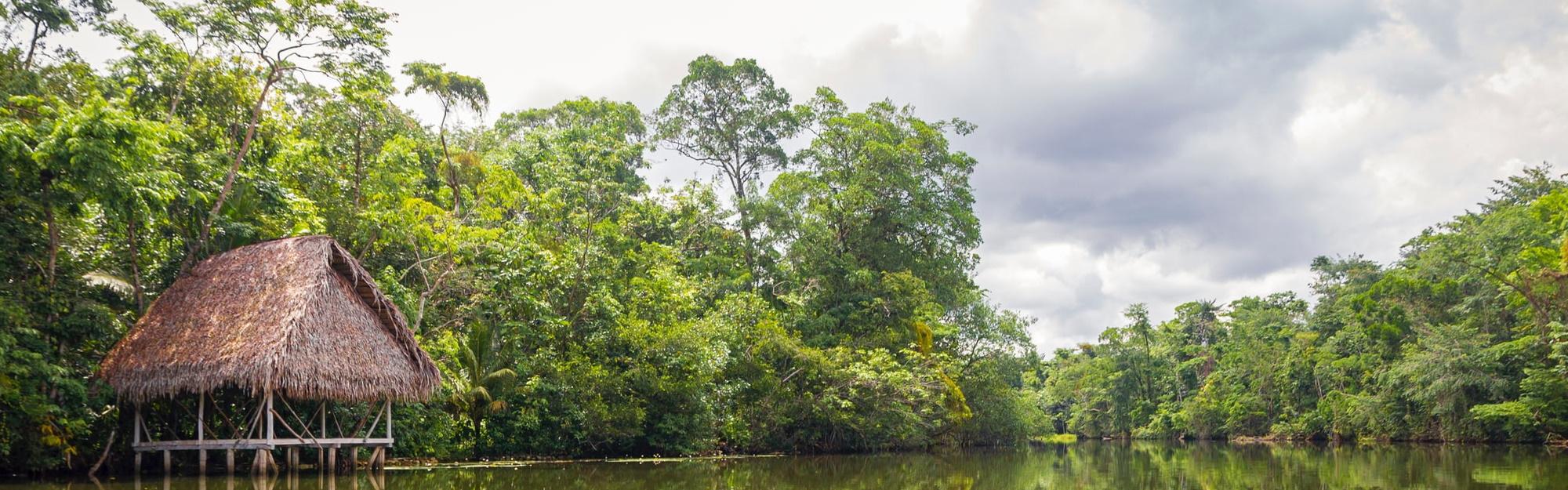

The Amazon Travel Guide
The Amazon is the largest rainforest on the planet, a vast expanse of rivers and lush greenery covering more than half of Brazil, as well as large tracts of its neighbouring countries. The Amazon River and its tributaries create approximately 30,888 square miles (80,000 sq km) of navigable river systems. The region is a veritable biodiversity hotspot, where one in 10 known species can be found. However, large areas of it remain unexplored, where tens of thousands of rare and unknown species of animals, birds, insects, fish and plants are thought to be sheltered beneath the dense canopies.
The Amazon is traversed by a multitude of rivers, the biggest of which is Rio Solimoes, a powerful but navigable course that enters Brazil from Peru, just above the city of Manaus. Close to the city, this river coverges with the Rio Negro to form the mighty Rio Amazonas, which flows through Brazil to the city of Belem.
Manaus is the gateway for excursions along the river system and into the jungle, situated as it is in the middle of the forest. From the city, scores of operators run day trips and longer boat tours for visitors wishing to experience Amazonian flora and fauna and meet the caboclos (residents of the river towns). The city itself does not have many attractions, apart from some interesting buildings, including an opulent opera house dating back to the height of the rubber boom in 1896. As the commercial hub of the state of Amazonas, Manaus is a buzzing little metro, with a noisy, crowded port and several bustling markets.
Belem is the other jumping off point for Amazon exploration, with a busy port, small airport and bus station. Located on the coast, it has a large number of indentations, estuaries and islands waiting to be explored. It has a few scenic buildings too, but more interesting are the markets near the quay.
The Amazon lacks extensive tourism infrastructure in the form of good hotels and reliable transportation, but ecotourism is gaining popularity and contributing to the enrichment of the environment and the lifestyle of the local people. For the intrepid traveller who seeks the road less travelled, the Amazon won't fail to impress.
Things to do in The Amazon
Those looking for bustling nightlife, luxury shopping trips and fancy restaurants in the Amazon will be disappointed.. For those who are keen to marvel at unrivalled natural wonders and have authentic experiences in one of the world's last mostly unspoilt locations however, the Amazon is just the ticket.The Amazon is one of the world's greatest natural wonders, home to 2.5 million insect species, tens of thousands of plants, and some 2,000 different kinds of birds and mammals. It teems with unique wildlife, from scarlet macaws, jaguars and giant anacondas, to poison dart frogs, piranhas and electric eels. The list of weird and wonderful creatures to tick off the list is endless.
In response to deforestation and climate change, the Amazon's tourism industry has started moving toward ecotourism; benefiting the local people, while also providing an unforgettable experience for visitors. The impact on the environment is always important to consider when travelling to undeveloped areas, and requesting things such as non-motorised boats and only qualified, locally-trained nature guides can make a big difference.
Because the Amazon is so large, there are a multitude of regions, each as uniquely fascinating and worthwhile as the next. Manaus is the largest city in the Amazon, with around two million inhabitants. It's a great base from which to travel, as one can find plenty of boat- and land trips into the jungle. Manaus has a variety of parks, beaches, a zoo and the wonderful Amazon Theatre for sightseers, and there are a number of lodges within range of Manaus that cater for tourists.
Belem is much smaller, with beautiful colonial architecture lining its streets, a number of interesting natural indentations and islands on its coast, and several bustling markets, including the Iron Market and the Ver-o-Peso, both near the waterfront.
There are many protected areas and national parks within the Amazon that provide great opportunities to interact with nature. Mamirauá Sustainable Development Reserve near Tefe is a protected area covered in swamp and flooded forest accessible by canoe. Its infrastructure is set up for ecotourism, including a unique floating lodge.
Cabo Orange National Park is the only protected area of the Amazon on the coastline, so the flora and fauna are unique to the rest of the rainforest. Infrastructure is lacking, but you can visit it from the nearby Oiapoque City. Cantão State Park has better facilities for tourists and an interesting topography that transitions from flat plains to rainforest.
The sun beats down mercilessly this close to the equator, especially during summer, so make sure to bring plenty of sunscreen, hats and other protective gear. Be careful not to remove any plants, animals or seeds from the rainforest, as poaching and smuggling are a big problem in the region and the authorities won't hesitate to prosecute.
The Amazon is rural and generally poverty-stricken, so tourists shouldn't expect to use credit cards outside of the cities. Tourists are overcharged as a rule, so it is always a good idea to haggle.
The Meeting of the Waters
The Meeting of Waters is an incredible natural phenomenon occurring when the dark waters of the Rio Negro join the lighter-coloured stream of the Rio Solimoes. The difference between the blackwater and whitewater rivers is stark, running side by side for a length of more than four miles (6km) without mixing. The separation is caused by differences in temperature, density and flow, with the resultant display a true wonder of nature. Becoming a major tourist attraction in Brazil, the Meeting of Waters is accessed via an hour's boat journey from the floating docks in Manaus.
Lake Janauari Ecological Park
An hour by boat from Manaus on the Rio Negro, this breathtaking park provides visitors with a taste of the Amazon experience, encompassing 22,240 acres (9,000 hectares) of forest, lowlands and flooded forest (igapos). Day package trips are available from Manaus, including lunch in a typical regional restaurant and a visit to the area's other main attraction, The Meeting of the Waters, as well as a canoe trip exploring the park's lakes and streams. Visitors can also spot the symbol of the Amazon at Lake Janauari Park: the famous Victoria amazonica, a water lily measuring up to seven feet (2m) in diameter, and ubiquitous atop the still shallow waters. The beautiful flowers only bloom for three days, changing colour from white to dark red before dying.
Adolpho Ducke Botanical Garden
This vast forest reserve, covering more than 39 square miles (100 sq km) to the east of Manaus, provides tourists with the opportunity to discover what lies beneath the dense Amazon canopy. The park building complex contains plant nurseries and an exhibition of the woods of Amazonas, as well as a library and an eatery. A network of trails has been created in the forest, and local youths are trained and employed as guides to direct visitors along the paths (although not all of them speak English). It can be difficult to get into the Amazon for a genuine experience of the rainforest and this vast botanical garden offers a convenient opportunity for a close look at a microcosm of this unspoilt forest world.
Getting Around
Road conditions tend to be poor in the region surrounding Manaus, which does present a safety concern when using buses for travelling beyond the city limits, but there is nonetheless a fairly comprehensive bus network. Taxis are plentiful in the city, but can prove expensive. Manaus is a popular starting point for river tours, and a number of nearby towns and cities, as well as tourist attractions, can be most comfortably reached by boat. Most major tourist attractions in the city are within walking distance and hiring a car is usually unnecessary.
The Amazon Climate and Weather
Manaus, and the surrounding Amazon, has a tropical monsoon climate with rainfall all year, but has a distinct rainy season nonetheless. Technically, the dry season is limited to the month of August, but notably less rain falls in the city between June and November. Temperatures are hot year-round, with very little seasonal variation, and the humidity is reliably high. Temperatures average between 73°F (23°C) and 95°F (35°C) all year.
Brazil travel info
Electricity
Brazil has a variety of electrical voltages, sometimes within the same city. The better hotels offer 220 volts, 60Hz. If not, transformers are available in electrical stores. Two-pin plugs with a grounding pin are standard.
Language
The spoken language in Brazil is Portuguese, however Spanish and English are also used in the cities.
Money
The Brazilian currency is the Real (BRL). The US Dollar is also welcome in most tourist establishments. In the main cities, foreign currencies can be exchanged at banks or cambios. There is an extensive network of ATMs in the country and most major international credit cards are accepted.
Tipping
Nearly all hotels add a service charge to the bill, usually 10 percent. Most restaurants also add 10 percent or more to the total of the bill, but must make it clear that they have done so; waiters appreciate another five percent if their service was good. Otherwise, a 10 to 15 percent tip is customary.
Brazilians don't normally tip taxi drivers, except if they handle bags, although they may round up the total. Hotel staff expect small tips, and most other service personnel such as barbers and petrol station attendants, are usually rewarded with a 10 to 15 percent tip. Parking attendants earn no wages and expect a tip of around two real.
Health
Mosquito-borne diseases like dengue fever and malaria are prevalent in Brazil, so insect repellent and protective clothing is essential if visitors will be travelling to the countryside. Malaria exists below 2,953 feet (900m) in most rural areas, and outbreaks of dengue fever occur frequently.
Visitors travelling from infected areas outside the country require a yellow fever certificate, and vaccination is recommended for those travelling to rural areas, as outbreaks have occurred in recent years.
Typhoid vaccinations are recommended if travellers intend to spend a lot of time outside of major cities. Milk in rural areas is not pasteurised, so it's best to avoid it. Hospitals in the major cities are fairly good, with cash and card payments both acceptable and travel insurance common.
Safety
In Brazil's metropolitan areas, crime is a fact of life. Rio, in particular, is regarded as one of the most crime-ridden cities in the world and, although violent crime is generally limited to the favelas, foreigners are advised to take precautions. Visitors should not attempt to visit these township areas, even on a guided tour. Violent crime is on the increase due to the establishment of drug and criminal gangs around Rio and São Paulo.
Muggings are frequent and visitors should dress down, conceal cameras and avoid wearing jewellery or expensive watches. Bank- and credit card fraud is common, including card cloning from ATMs, so tourists should keep sight of their card at all times and not use an ATM if they notice anything suspicious.
Thefts are common on public beaches and visitors should avoid taking valuables to the beach. The threat of personal attack is lower outside the main urban centres, but incidents do occur. Women should be aware that sexual assaults have been reported in coastal holiday destinations. Beware of unofficial taxis and those with blacked-out windows, and be particularly careful on public transport in Rio, Recife and Salvador.
Local customs
Brazil is a diverse cultural and ethnic melting pot, but most social customs will be familiar to visitors. As a result of three centuries of colonisation by the Portuguese, the Brazilian culture is actually recognisably European in many ways. Physical appearance is considered important by most Brazilians and care is taken to dress well but generally not too formally.
Doing business
Business practices vary quite substantially from city to city in Brazil: highly formal in São Paulo but more relaxed in Rio de Janeiro and other centres. Multinational companies have similar business etiquette to those in Europe or the US, while local businesses require a few more considerations, particularly preferring face-to-face meetings over phone calls or written communication.
Brazilians place a high value on personal relationships within business environments and will generally only conduct business through personal connections or with those whom they have already established a personal relationship. Nepotism is considered not only acceptable but actually desirable, because it is seen as ensuring trust and good relationships in business.
All meetings are preceded by handshakes and small talk, and visitors should avoid the temptation to rush things. Even after the meeting is over, it's considered rude to rush off. Entertaining is common, either at a restaurant or someone's home, again with the emphasis on building personal relationships. Punctuality is flexible, except when meeting at a restaurant, when tardiness is considered impolite, and a small gift or flowers for the host is common when invited to a home.
Business suits are expected, especially for first meetings. Portuguese is the dominant language, and although English is widely spoken in business, an interpreter might be required. Business cards, as well as written documents, should be printed in both English and Portuguese. Business hours are 8.30am to 5.30pm Monday to Friday.
Duty free
Travellers to Brazil can enter the country with 200 cigarettes or 25 cigars; 24 units of alcoholic beverages, with a maximum of 12 units per type of beverage; and goods to the value of USD 500, without incurring customs duty. Restricted items include fresh produce, meat and dairy products. Strict regulations apply to temporary import or export of firearms, antiquities, tropical plants, medication and business equipment.
Communications
The international access code for Brazil is +55. Hotels, cafes and restaurants offering free WiFi are widely available in tourist centred areas. As international roaming costs can be high, purchasing a local prepaid SIM card can be a cheaper option.
Passport & Visa
All visitors require passports that are valid for at least the period of intended stay in Brazil but we strongly recommend that passports be valid for six months after intended date of travel. Border control may well deny entry to holders of passports valid for the period of intended stay. Sufficient funds to cover their stay in Brazil, as well as a return or onward ticket and documentation required for further travel, are necessary for all travellers. Visa requirements vary from country to country.
Entry requirements
US passports must be valid for the duration of stay. Tourists can stay in the country without a visa for up to 90 days.
UK passports must be valid for at least six months after the date of arrival. UK passport holders do not require a visa for stays of up to 90 days.
Canadian passports must be valid for six months beyond the departure date. Tourists can stay in the country without a visa for up to 90 days.
Australian passports must be valid for six months beyond the date of entry. Tourists can stay in the country without a visa for up to 90 days.
South African nationals need a passport that is valid for the duration of their stay, but do not require a visa for up to 90 days.
Irish nationals need a passport that is valid for the duration of their stay, but do not require a visa for stays of up to 90 days.
New Zealanders need a passport that is valid for the duration of their stay, but do not require a visa for up to 90 days.
Useful contacts
Brazilian Tourist Institute, Brasília: +61 429 7704 or presedencia@embratur.org.br
Emergencies: 190 (police), 192 (ambulance)