

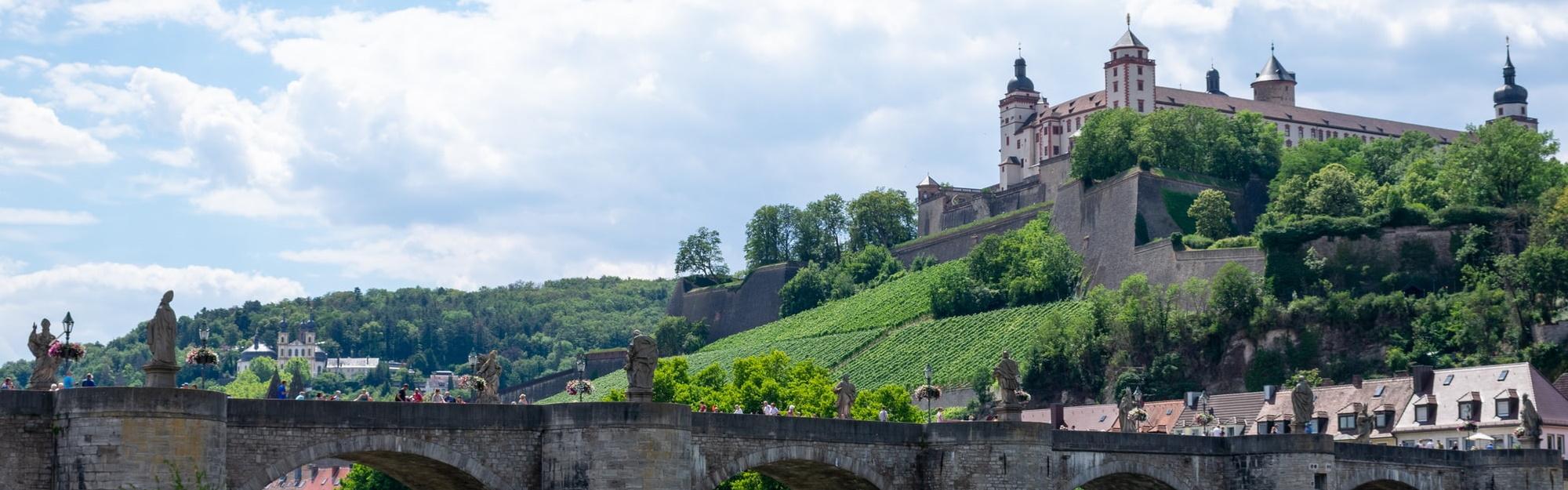

The Romantic Road Travel Guide
A former trade route, Germany's Romantic Road is a 220-mile (350km) portion of highway stretching from central Germany to the southern border with Austria. A popular route for holidays in Germany, the Romantic Road is actually a modern concept meant to encapsulate the typically Bavarian atmosphere and culture of the villages and towns along the way.
Easy to follow, with signs posted in several languages, the Romantic Road is an ideal route for seeing fairytale castles and charming, quintessentially German towns. Travellers should note that the route is so popular now that the best sites tend to be overrun with tourists in the peak summer months (June to August). Spring and autumn are good alternatives for those who prefer to skip the crowds.
The Romantic Road starts in Wurzburg, a town famous for its wineries and gourmet restaurants. Visitors should be sure to see the Residence Palace, a UNESCO World Heritage Site. From there, the road goes to Rothenburg ob der Tauber and Dinkelsbühl, two of the best-preserved medieval towns in Germany, and the 1,000-year-old Castle Hotel Colmberg. The 2,000-year-old town of Augsburg, an old Roman trading centre, features beautiful buildings and traditional Bavarian restaurants. Pfaffenwinkel and Neuschwanstein are key stops on the route, famous for their churches, castles, and pretty rolling countryside.
There are many ways to travel the Romantic Road: by train, bus tour, car or even bicycle. Hop-on, hop-off bus tickets are available from Frankfurt, and bicycles can be hired at any train station for only a few euros.
Things to do in The Romantic Road
The Romantic Road was a trade route during the middle ages and has retained its historic appeal. The well-trodden tourist track winds through lovely countryside, fortified medieval towns and picturesque old villages. Attractions along the Romantic Road include the ancient walls, gates and guard towers of the villages, Gothic cathedrals and fairytale fortresses, half-timbered houses, historic hotels and even medieval festivals.
There are many famous places to visit along the Romantic Road. Augsburg, the route's largest city and one of the oldest in Germany, offers visitors the chance to explore 2,000 years of history. Dinkelsbühl, still protected by 16 towers and 10th-century walls, is full of cobbled streets and 16th-century houses. Rothenburg, known to be the best-preserved medieval town in Germany, has fortifications and other buildings dating back to the 13th century, while Wurzburg is a lively little town with a hundred churches and a UNESCO-listed Residential Palace.
There are a number of delightful castles and fortresses to be discovered along the route, which is often simply called the German Castle Road. Some of the highlights for castle enthusiasts are the Burg Harburg Castle; the 1,000-year-old Castle Hotel of Colmberg, where visitors can spend the night; the Heidelberg Castle in the charming town of the same name; the three castle ruins of Eberbach; Langenburg Castle; and the famous Neuschwanstein. Neuschwanstein is one of the most famous castles in the world and marks the end of the Romantic Road. The interiors are as rich and magical as the facade and definitely worth investigating.

Neuschwanstein Castle
Neuschwanstein Castle was built by Mad King Ludwig II and has become a Bavarian trademark, with its pale Gothic facade rising from a green hill. Day tours from Munich travel to the castle and visitors also drive from Garmisch. From the parking lot there is a steep half-mile (1km) climb to the fairytale fortress, with indulgent guests preferring a horse-drawn carriage ride to the gates. The interior is extravagant, particularly the king's apartments, which are decorated entirely with hand-embroidered silk, carvings and elaborate wall and ceiling paintings. The rooms can only be visited as part of a guided tour and no photography or filming is allowed in the castle.
Würzburg
A popular starting point for the Romantic Road, Würzburg is nestled in a picturesque location in the heart of the Franconian wine region of rolling hills, pretty vineyards. Famous for its 100 churches and the Residential Palace, the city's architecture is composed heavily of baroque and rococo pieces and are best viewed from the Alte Mainbrucke, an old pedestrian bridge. The 12th-century Marienburg Fortress sports lovely gardens and a museum, and travellers adore the Würzburger Cathedral, one of the largest Romanesque churches in Germany. Würzburg is far from quiet and sleepy, as its student population maintains a vibrant nightlife, and colourful wine festivals add to the appeal.
Rothenburg
Known as the best-preserved medieval town in Germany, Rothenburg is an absolute must see for anyone travelling on the Romantic Road. The 13th-century fortified walls are undamaged, encircling a quaint city centre with a number of charming buildings and fascinating museums. Enjoying stunning views from the top of the Town Hall tower or exploring the old walls are great ways to gauge the look and feel of this fairytale cityscape. The Medieval Crime Museum is a popular excursion with visitors, while the Lutheran church of St Jakob is also a must for those interested in medieval art and architecture, its wood carvings and stained-glass windows dating back to the 14th century. After a day out on the ramparts, the town's walled garden is a lovely place to stroll, relax or picnic.
Dinkelsbühl
A less-crowded alternative to Rothenburg, Dinkelsbühl is a scenic medieval town on the Romantic Road. Surrounded by 16 towers along fortified 10th-century walls, the town centre is lined with picturesque 16th-century houses, churches and a few enthralling historical museums. Leisurely strolls or bike rides along the perimeter of the fortified old town are great ways to get to grips with its charming secrets. One of the main highlights of Dinkelsbühl is the massive 15th-century Parish Church of Saint George, where entry is free and a quick climb up the tower affords amazing views. And lastly, no visit to Dinkelsbühl is complete without sampling the gingerbread, a local speciality.
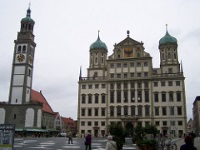
Augsburg
The largest city along the Romantic Road, picturesque and traditional Augsburg is also among the oldest cities in Germany with a history stretching back 2,000 years. It boasts many interesting buildings, including several ornately decorated churches and Baroque houses. Some of the city's most impressive old architecture includes the 9th-century cathedral, the 1620 town hall, the Perlachturm bell tower built in 989, and the Schaezlerpalais, which is a mansion dating back to 1765. Other popular tourist attractions in Augsburg include the Puppet Theatre and Museum, the zoo and the botanical garden. Known for its traditional German restaurants, it's a popular stop both on the Romantic Road and on journeys to the Bavarian Alps in the south.
Germany travel info
Electricity
230 volts, 50Hz. European-style two-pin plugs are standard.
Language
German is the official language. English is also widely spoken and understood.
Money
The unit of currency is the Euro (EUR), divided into 100 cents. ATMs and exchange bureaux are widely available. The major credit cards are widely accepted in large shops, hotels and restaurants. The quickest and most convenient way to change money is to obtain cash from one of the ATMs that are ubiquitous features on all German streets. Banks are closed on weekends, but exchange bureaux at airports and main railway stations are open daily.
Tipping
German law stipulates that all prices, menus and bills include both tax and a service charge, so tipping is not necessary in restaurants. Cleaning staff, hairdressers, taxi drivers and other menial services appreciate small tips.
Health
There are no serious health risks for visitors to Germany and no vaccinations are required. The German health service is excellent and there is a reciprocal health agreement with most EU countries, whose citizens are entitled to free medical and dental treatment on presentation of a European Health Insurance Card (EHIC). After Brexit, the Global Health Insurance Card (GHIC) replaced the European Health Insurance Card (EHIC) for UK citizens. The GHIC allows UK citizens access to state healthcare during visits to the EU. The GHIC is not valid in Norway, Iceland, Liechtenstein or Switzerland, nor is it an alternative to travel insurance. Nationals of other countries should take out travel insurance.
Safety
A visit to Germany should be trouble free, but visitors should take normal precautions to avoid mugging, bag-snatching and pick-pocketing, especially at airports, railway stations and markets in the large cities.
Local customs
Visitors are not required to carry their passports with them at all times in Germany, but carrying some form of identification is advised. Smoking in public places such as bars and restaurants is illegal.
Doing business
In Germany, business is conducted in a formal manner, with a conservative and formal dress code being the norm. Punctuality is vital at all meetings and it's considered rude to be late. Germans use titles often, with men referred to as 'Herr' and women as 'Frau', followed by their last names.
Meetings are often purely business and may not occur over lunches, which are generally more social. Shaking hands at the beginning and end of the meeting is common. Business hours are generally 9am to 6pm Monday to Friday, with an hour taken over lunch.
Duty free
Passengers arriving from EU countries can enter Germany without paying duty on 800 cigarettes or 400g cigarillos or 200 cigars or 1kg tobacco; 90 litres of still wine; 110 litres of beer; and 10 litres of alcohol stronger than 20 percent or 20 litres of fortified wine, sparkling wine or other liqueurs up to 22 percent.
Passengers arriving from non-EU countries, over the age of 17, can enter Germany without paying duty on 200 cigarettes or 100 cigarillos or 50 cigars or 250g smoking tobacco; 4 litres of wine and 16 litres of beer and 1 litre of spirits over 22 percent volume; or 2 litres of spirits under 22 percent volume. Other goods to the value of €430 for travellers arriving by air or sea, and €300 for travellers arriving by land.
Communications
The international access code for Germany is +49. Travellers will find it easy to use a local SIM card, Skype, WhatsApp or similar apps. Free WiFi is available in most hotels, cafes and restaurants.
Passport & Visa
The borderless region known as the Schengen Area includes the following countries: Austria, Belgium, Czech Republic, Denmark, Estonia, Finland, France, Germany, Greece, Hungary, Iceland, Italy, Latvia, Lithuania, Luxembourg, Malta, The Netherlands, Norway, Poland, Portugal, Slovakia, Slovenia, Spain, Sweden, and Switzerland. All these countries issue a standard Schengen visa that has a multiple entry option, and which allows the holder to travel freely within the borders of all the aforementioned countries. Additionally, non-EEA members require proof of onward or return tickets, the necessary travel documentation for their next destination, and sufficient funds to support themselves while in Germany. Citizens of Australia, Canada, Israel, Japan, New Zealand, Switzerland, and the USA are exempt from the requirement to hold onward tickets.
It is highly recommended that travellers' passports have at least six months' validity remaining after the intended date of departure from their travel destination. Immigration officials often apply different rules to those stated by travel agents and official sources.
Entry requirements
US citizens must have a passport that is valid for three months beyond the intended period of stay in Germany (and issued within the last 10 years). A visa is not required for stays of up to 90 days within a 180-day period.
UK citizens must have a passport that is valid for three months beyond the intended period of stay in Germany (and issued within the last 10 years). A visa is not required for stays of up to 90 days within a 180-day period.
Canadian citizens must have a passport that is valid for three months beyond the intended period of stay in Germany (and issued within the last 10 years). A visa is not required for stays of up to 90 days within a 180-day period.
Australian citizens must have a passport that is valid for three months beyond the intended period of stay in Germany (and issued within the last 10 years). A visa is not required for stays of up to 90 days within a 180-day period.
South African citizens must have a passport that is valid for three months beyond the intended period of stay in Germany, with at least two blank pages, and must obtain a valid Schengen visa prior to travel.
Irish citizens must have a passport that is valid for three months beyond the intended period of stay in Germany (and issued within the last 10 years). A visa is not required.
New Zealand citizens must have a passport that is valid for three months beyond the intended period of stay in Germany (and issued within the last 10 years). A visa is not required for stays of up to 90 days within a 180-day period.
Useful contacts
German National Tourist Board, Frankfurt: +49 (0)69 751 903 or www.germany-tourism.de
110 (Police); 112 (Ambulance/Fire)