


Tibet Travel Guide
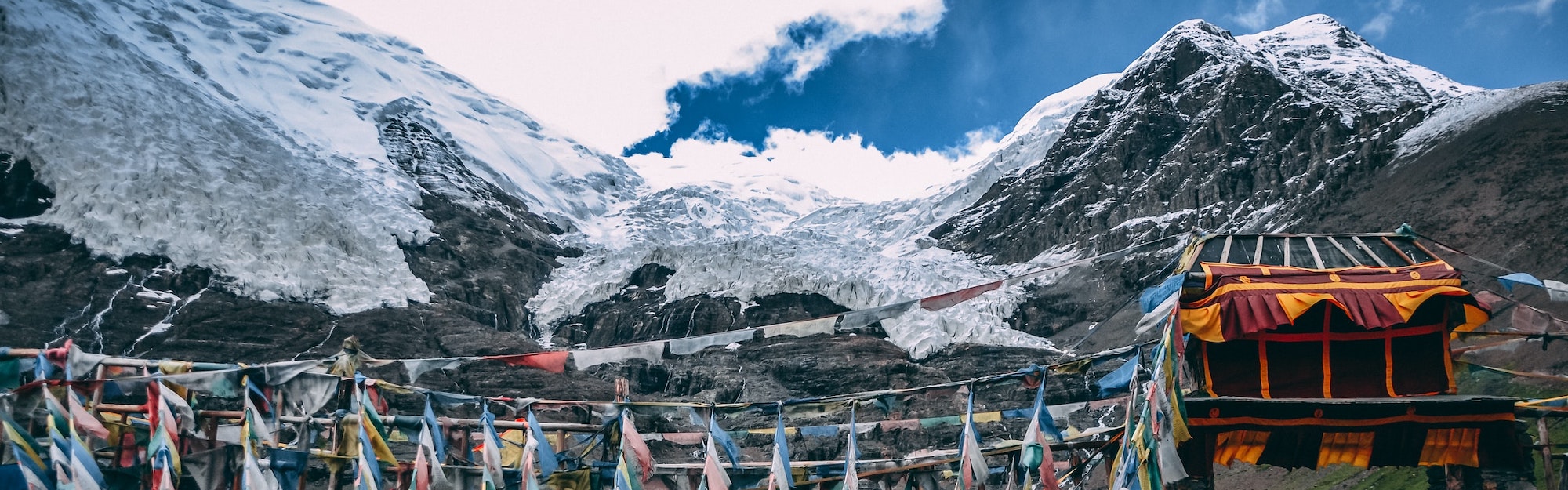
Tibet, 'the roof of the world', is a land of dramatic mountain ranges, stark open plains and unique culture. It lay largely undiscovered by outsiders until the beginning of the 20th century, but now captures the world's imagination with fascinated travellers flocking to these unspoilt mountainscapes.
The vast Tibetan territory consists of a massive plateau surrounded by towering mountain ranges: the Himalayas to the south; the Karakoram to the west; the Kunlun to the north; and smaller ranges fringe the east, forming a barrier between Tibet and China's internal provinces. Most of Tibet is several thousand feet above sea level, meaning that the air is thin, but the region is a major draw for mountaineers, containing some of the world's highest and most picturesque mountain peaks, capped by Mount Everest at 29,029 feet (8,848m).
Tibet is unbelievably scenic, with towering snow-covered peaks, glaciated high passes, aquamarine lakes and primeval forests. Despite its altitude and thick snow and ice covering the mountains, Tibet actually has snowfall only a few times each year, with plenty of sunshine the rest of the time. Tibet's major cities and towns are congregated mainly in the southern part of the region; the capital Lhasa and the other major city of Shigatse offer the region's most well-known tourist attractions, including the Summer Palace of the Dalai Lama and the Rongbuk Monastery, which is the highest in the world and has fantastic views of Mount Everest.
The Chinese presence in Tibet is due to their invasion and annexation of it in 1950, with the region officially known since then as the Tibet Autonomous Region. Travelling through Tibet is sadly no longer permitted unless visitors are part of an organised tour booked through an authorised tour operator. However, those who prefer to travel outside of big groups can still be granted permits so long as they have a guide and an itinerary booked through their tour operator.
Travellers must be careful to remain with their tour guide for the duration of their stay. Luckily, tours of Tibet are plentiful and varied and itineraries can be arranged according to individual preference. But travellers should bear in mind that China occasionally suspends travel permits to Tibet due to political tension. In recent years, there has been a massive influx of Han-Chinese immigrants to Tibet, and Chinese-Tibetan relations can be strained at times. But Tibetan locals are famously friendly and hospitable to foreign visitors.
Things to do in Tibet
The region of Tibet is a paradise for those who prefer to travel off the proverbial beaten track. The Tibet Autonomous Region is unbeatable in terms of natural beauty, but there are also a multitude of cultural and historical tourist attractions to be discovered.
Lhasa, the capital city, is a good place to start, as it has been the global religious centre for Lamaist Buddhists since ancient times and offers an array of interesting things to see and do. The Jokhang Temple in Lhasa is arguably Tibet's most sacred temple and is a popular destination for pilgrims. Lhasa is often filled with pilgrims, adding to the atmosphere of devotion, peace, and majesty. Just above the city looms the famous Polata Palace, which was the official residence of the Dalai Lama for centuries and is celebrated as the greatest achievement of Tibetan architecture.
Many tours of Tibet include a visit to Shigatse, a city en route to Mount Everest, not far from Lhasa. On the way, travellers can stop off at the Palkhor Monastery and Tashi Lhunpo Monastery, the seat of the Panchen Lama. The Sakya Monastery in Shigatse is particularly popular with visitors.
Travellers interested in ancient civilisations and archaeology can venture further afield to Guge in Zana County, where they'll find the truly enthralling remains of an ancient kingdom. Guge is more difficult to access than some of the other sites, but it's worth the extra effort for those who prefer attractions that are off the main tourist route.
Of course, many travel to Tibet for the magnificent landscapes and mountains and, in this regard, the region will not disappoint. Apart from the notorious Mount Everest, the world's highest peak, there are innumerable scenic areas worth exploring. Stunning natural areas include Ranwu Lake and Valley, in Basu County, and Basongcuo Lake Tourist Area, in Gongbo'gyamda County. When it comes to untamed wilderness, travellers to Tibet are spoiled for choice.
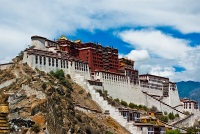
Potala Palace
The vast Potala Palace stands on a cliff top above Lhasa, considered the greatest achievement of Tibetan architecture. The palace was originally built in the 7th century by the then emperor for his bride. It was later partially destroyed by lightning and war, but restored and extended in 1645 by the Fifth Dalai Lama when he became the political and religious leader of Tibet. The Fifth Dalai Lama took up residence in the palace in 1653, and it remained the Dalai Lama's official residence until the exile of the 14th Dalai Lama in 1959.
The palace is renowned for its interior splendour. It consists of two main sections: the White Palace which is the secular section containing offices, dormitories, a Buddhist seminary and printing house; and the Red Palace, which is the sacred sanctuary dedicated to religious study and prayer. The latter contains chapels where the mummified remains of three Dalai Lamas lie, and the Great West Hall famous for its rich murals. The only remaining structures dating from the 7th century are the Dharma Cave and the Saint's Chapel, but the palace houses many ancient cultural treasures and relics. In fact, the palace contains over 10,000 shrines and 200,000 statues.
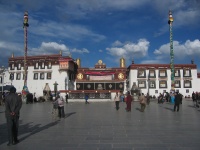
Jokhang Temple
The Jokhang Temple lies in the heart of Lhasa. It was built nearly 1,300 years ago but remains the spiritual centre of Tibet, drawing pilgrims from all over the region who come to demonstrate piety to the Buddha. The original structure was enlarged under the reign of the Fifth Dalai Lama and it now stands as the product of Han, Tibetan and Nepalese architectural design. It is a four-storey timber temple with a golden roof that contains a number of valuable cultural relics, sacred sculptures and magnificent murals.
Possibly the most special statue is the site's original sculpture of Buddha called Jowo, which is richly decorated with jewels and silk. An annual prayer festival is held in the temple, which is also the venue for the initiation of the Dalai Lamas. The Jokhang Temple is a UNESCO World Heritage Site and it is generally considered to be Tibet's most sacred and important temple.
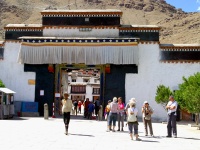
Tashi Lhunpo Monastery
Tashi Lhunpo is one of Tibet's most revered and influential monasteries, lying about a mile (2km) to the west of Shigatse at the base of Drolmari Mountain. Founded by the First Dalai Lama in 1477, it became the seat of Tibet's second most important spiritual leader, the Panchen Lama, in 1713. The monastery today houses about 800 monks in its 3,229 square foot (300 sq m) of muraled buildings.
The oldest section is the main chanting hall that houses the throne of the Panchen Lama. The tallest section is the Maitreya Chapel, which contains the world's largest brass statue of Maitreya. The seated figure is 86 feet (26m) high and decorated with gold, pearl, amber, copper, coral, diamonds and other precious stones. It's said that it took 900 craftsmen nine years to complete the statue.
There are other treasures such as the remarkable Thangka Wall, which is nine floors high and used to display massive images of Buddha on important days in the Tibetan Lunar Calendar.
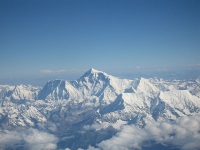
Mount Everest
The Shigatse prefecture is the gateway for climbers to the North Col route of the world's highest mountain. The ultimate climber's challenge, Mount Everest towers at 29,028 feet (8,848m) on the border between Tibet and Nepal. Access to the Everest Base Camp is via the town of Tinggri. About 20 miles (30km) from the town, climbers embark on a 48-mile (78km) trek to the first camp.
About six miles (10km) from the base camp is Rongbuk Monastery, the highest monastery on earth at an altitude of 16,728ft (5,099m). The monastery is continually being restored and offers hostel accommodation. Just south of the monastery is the world-renowned Rongbuk Glacier.
Because of its height, adventurers wishing to climb Mount Everest will need to allow several weeks simply to acclimatise to the thin atmosphere. Climbing Mount Everest is not to be attempted without the aid of a guide, and should only be tackled by extremely experienced climbers. Numerous travel agencies offer package multi-day hikes around the area and up to the Everest base camp.
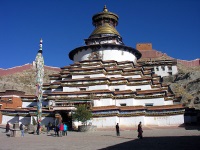
Pelkor Monastery
The fascinating Pelkor Monastery is situated at the foot of Dzong Hill in Tibet. Also called Baiju Monastery, it has an unusual structural style incorporating Han, Tibetan and Nepali influences. The main structures were built around the beginning of the 15th century, and now house richly embroidered Tibetan opera costumes of pure silk dating to the Ming and Qing dynasties. It's unique in that it's the only monastery to accommodate monks from three different Buddhist orders. A popular pilgrimage site, it houses a number of shrines, frescoes and the renowned Arhat clay sculptures. But the most famous attraction at Pelkor Monastery is the Bodhi Dagoba, a building consisting of nine tiers, 108 gates and 76 shrines to Buddha.
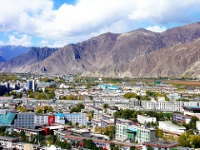
Lhasa
Lhasa is a holiday destination set in a marshy valley dominated by surrounding mountain peaks. It is the capital of the Tibet Autonomous Region and one of the highest cities in the world at an elevation of 12,000ft (3,658m). Lhasa has long been the religious, cultural and political centre of Tibet, sheltered from the harsh winds of the Tibetan plateau in a spot that has been inhabited for at least 1,500 years.
Being the religious centre for Lamaist Buddhists since ancient times, flocks of pilgrims have made their way to Lhasa over the centuries to worship at the feet of the Dalai Lama. Now tourists on holiday are following in their wake to explore the surrounding mountains and investigate Tibet's unique culture and long history. While the city is currently enjoying a period of rapid modernisation, it retains its importance and aura as a holy city.
Getting Around
Tibet is relatively undeveloped compared to the rest of China and, as such, does not have much in terms of public transportation infrastructure. Despite considerable plans for development, it is unlikely that public transport in Tibet will improve significantly any time soon. Public transport is not really a concern for travellers, however, as they are required to organise their itineraries through tour operators and should at all times be accompanied by a guide and driver when exploring Tibet. Tourists are prohibited from traveling outside Lhasa independently. The Tibet Transportation Co-Op is the government-approved option for car rental and 4x4 vehicles are the most popular choice. For package tours with big groups the cost of the vehicles is invariably included but individuals and small groups on private tours may need to organise car rental themselves. Either way, their tour operator should advise them.
Tibet Climate and Weather
Tibet has a peculiar climate due to its unique topography and high altitude. The weather is harsh because the air is thin and temperatures can rise or drop suddenly. Tibet has a dry, cold climate and is particularly cold in the mountains and plateaus, which are swept by strong winds all year round. In summer (June to August), the daily temperature fluctuates greatly between day and night. At midday it may be 80F (27C), but after sunset the mercury plummets abruptly to as low as 32F (3C). There is more sunshine in Tibet than many would expect, which prevents temperatures getting too low during the day. It does also make ultraviolet rays a problem for travellers, so they should be sure to take plenty of sunscreen no matter what the season. July and August are the wettest months, particularly in the central area around Lhasa, but average annual precipitation is actually very low. Northern Tibet experiences frequent thunderstorms and hail during the rainy months.
The best time of year to visit Tibet is between April and October, when the weather is mild. This only really applies to the central and southeast regions of Tibet though; the best months to visit the north are July and August, as winter at this altitude is freezing.
China travel info
Electricity
Electrical current is 220 volts, 50Hz. Plug types vary, but the two-pin flat blade and oblique three-pin flat blade plugs are common. Adapters are generally required.
Language
The official language is Mandarin Chinese, but there are hundreds of local dialects.
Money
China's currency is the Renminbi Yuan (CNY), which is divided into 10 jiao or 100 fen. Cashless payments via smartphone applications such as WeChat Pay are increasingly commonplace in main cities, and major credit cards are widely accepted. ATMs are widely available in major cities. It is not possible to exchange Scottish or Northern Irish bank notes; banks are closed on weekends.
Tipping
Tipping is not officially recognised in China, though the practice is has become increasingly common among tour guides, top-end restaurants, tour bus drivers and hotel staff. Travellers wanting to tip should leave a gratuity of about 10 percent. Large hotels and restaurants often include a service charge in their bills, usually of around 10 percent, so travellers should make sure that they aren't doubling up.
Health
A yellow fever vaccination certificate is required from travellers coming into China from infected where there is a risk of transmission. There is a risk of malaria throughout the low-lying areas of the country, and it is recommended that travellers to China seek medical advice about malaria before departure. All eligible travellers should be up to date with their COVID-19 vaccines; vaccinations are recommended against hepatitis A and hepatitis B, typhoid (not necessary if eating and drinking in major restaurants and hotels), Japanese encephalitis (usually only recommended for rural areas), and rabies (only recommended for travellers at risk of animal bites). Tap water shouldn't be drunk unless it has first been boiled, filtered or chemically disinfected. Street food should be treated with caution. High levels of air pollution in major cities and industrialised areas in China may exacerbate bronchial, sinus or asthma conditions. There is generally a high standard of health care in major Chinese cities, but it is not provided free of charge; travellers are advised to have comprehensive travel health insurance.
Safety
China is one of the safety countries to visit in Asia. Serious crime against foreigners is rare but does occur, particularly in isolated or sparsely populated areas. If travelling alone, including following parts of the Great Wall, it is advisable to leave an itinerary and expected time of return with a third party. Travellers should take extra care in street markets and at tourist sites, which attract thieves and pickpockets, and around the popular expat bar areas at night, where lone foreigners have occasionally been targetted. Travellers should be cautious about using pedicabs in Beijing, as tourists have reportedly been mugged by the drivers. Disputes over taxi fares can occur. Passengers should insist on paying the metered fare and should ask for a receipt; this has the taxi number on it.
Seasonal heavy rains and typhoons cause hundreds of deaths in China each year, particularly those areas bordering the Yangtze River in central, southern and western China. Demonstrations have taken place in Lhasa, Tibet, as well as in some Chinese provinces in protest against Chinese rule in Tibet. Even though the situation seems to have stabilised, visitors are advised to stay up to date on the situation before travelling to the region and to avoid all protests. The Chinese government sometimes suspends the issue of permits for travel to Tibet due to unrest.
There is currently little threat from global terrorism. The risk of terror attacks is higher in the Xinjiang Uyghur Autonomous Region and travellers should exercise caution if travelling to or around Xinjiang.
Local customs
Chinese people usually have three names, the first of which is their surname, or family name. As a result, visitors should be prepared for hotels mistakenly reserving rooms under their first names. For clarity, surnames may be underlined. When addressing Chinese people, the surname should come first and official titles should be used. Chinese handshakes last longer than those in western countries, and it is customary to stand close together when in conversation. Politeness in western terms is often foreign to the Chinese, and they rarely bother with pleasantries. It is considered disrespectful to keep prolonged eye contact, avoiding eye contact is considered reverential rather than rude. All foreigners should carry their ID on them at all times, as spot checks are common. Failure to show evidence of ID when requested by an official may result in a fine or detention.
Doing business
The Chinese are strict timekeepers and being late for a meeting is considered rude. When meeting people for the first time it is normal to shake hands and say 'ni hao', which means 'how are you'. Handshakes generally go on for longer in China than in most western countries. Business cards are commonly exchanged at the start of meetings in China; it is customary to have one side printed in Chinese and one in English. When giving or receiving business cards or a gift, it is customary to hold it with both hands. Chinese consider gifts an important show of courtesy. Decision-making may take longer than expected during negotiations. During a meal or reception, a host is likely to offer a toast; foreigners may be expected to offer them one in return.
Women are generally treated with respect and courtesy when doing business in China and it is increasingly common to find Chinese women in senior positions, especially in the big cities. Businesswomen should, however, avoid showing too much skin. Business dress for both men and women tends to be conservative and plain without much ornament or bright colour.
Business hours are 8am to 5pm, Monday to Saturday. A five-day week is more common in larger cities and international companies. Workers usually take their lunch break between 12pm and 2pm and it is not unusual to find offices empty during this time.
Duty free
Travellers to China do not need to pay customs duty on 400 cigarettes or 100 cigars or 500g of tobacco; 1.5 litres of alcohol; perfume for personal use; and personal articles up to the value of CNY2000. Prohibited goods include arms, ammunition, or printed material that conflicts with the public order or moral standards of the country. Also prohibited are radio transmitters and receivers, exposed but undeveloped film and fresh produce. Strict regulations apply to the import and export of antiquities, banned publications, and religious literature. All valuables must be declared on the forms provided.
Communications
The international dialling code for China is +86. Hotels, cafes and restaurants offering free WiFi are widely available. As international roaming costs can be high, purchasing a local prepaid SIM card can be a cheaper option.
Passport & Visa
There are a few complex exceptions to Chinese visa requirements, which will not apply to the majority of visitors, but all requirements should be confirmed with a Chinese embassy before travel. All documents necessary for further travel and sufficient funds to cover intended period of stay are required; travel to Tibet will require a special Tibet Entry Permit. It's recommended that passports be valid for six months after intended period of travel.
Entry requirements
US nationals require a passport that is valid for six months after the date of departure. A visa is required for entry into China.
UK nationals require a passport that is valid on arrival for six months after the date of departure. A visa is required for entry.
Canadians require a passport that is valid for six months at the time of entry. A visa is also required.
Australians require a passport valid on arrival, and a visa for entry to China. A valid visa is required.
South African nationals require a passport valid on arrival, and a visa for entry to China.
Irish nationals require a passport valid on arrival, and a visa for entry to China.
New Zealand nationals require a passport valid on arrival, and a visa for entry to China.
Useful contacts
Ministry of Culture and Tourism, Guangxi: +86 773 288 5326, www.topchinatravel.com/
110 (Police); 120 (Ambulance)