


Vinales Valley Travel Guide
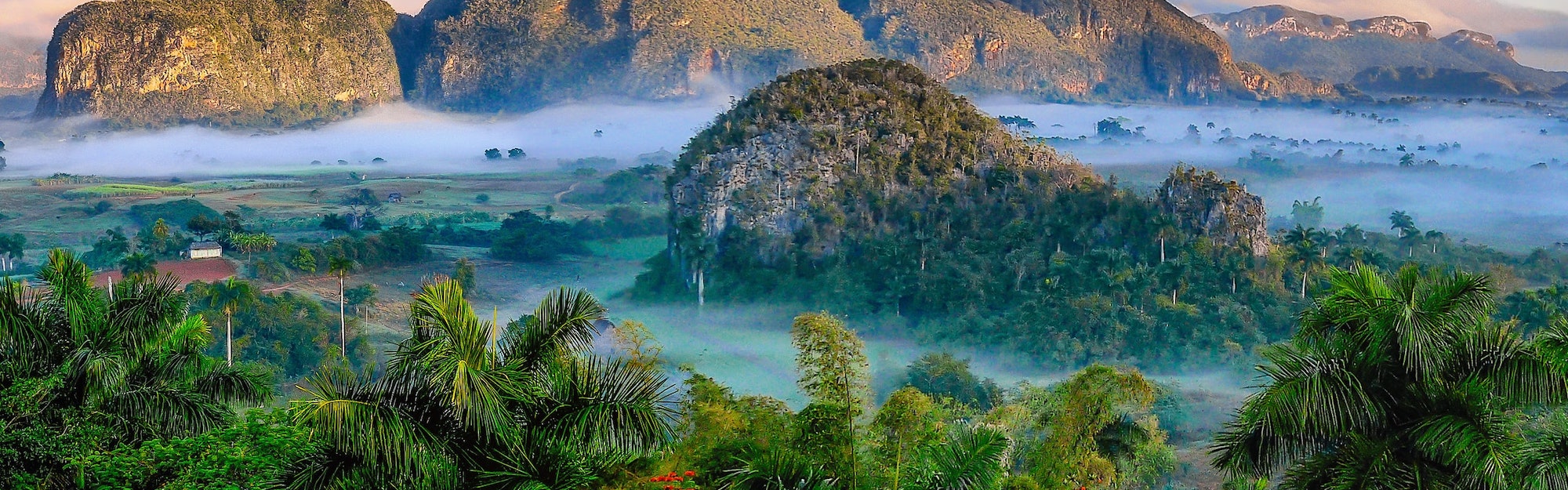
A recent addition to the UNESCO World Heritage list, the town and valley of Vinales are found in the green province of Pinar del Rio. It's characterised by impressive round-topped hills called mogotes that date back to the Jurassic period and are covered with rich and varied vegetation. They are thought to be remnants of the plateau that was eroded by a network of underground rivers millions of years ago.
The Vinales Valley is located about 112 miles (180km) west of Havana, making it a good day-trip destination or weekend getaway. The valley is beautiful, a patchwork of nature's bounty mixed with green fields of tobacco, coffee and other crops that grow out of the rich red earth. Scattered palm trees and pine forests shelter a variety of melodious birds, while the region is also a magnet for speleologists and cave enthusiasts with its abundance of limestone caves and caverns.
The hilly landscape, quaint villages, oxen-ploughed fields, rustic barns and underground cave systems and rivers, provide a striking contrast to the faded colonial grandeur and white sandy beaches found on the rest of the island. The main valley village is Vinales, a charming and laid-back place that makes a good base for exploring the lovely countryside.
Things to do in Vinales Valley
Glorious landscapes are the primary attraction of Vinales Valley, with odd round hills (magotes) and bright orange soil beneath striking greenery making the prehistoric-looking valley a unique and absorbing destination for travellers in Cuba. For a more authentic and intimate experience, tourists should avoid the tour buses and get a local guide to show them around the tobacco farms, caves and sites such as the Prehistoric Mural. Walks organised by the municipal museum allow locals to explain and show the ancient farming techniques still used by local farmers, while there is also a hop-on, hop-off bus for tourists that stops at all the main attractions in Vinales Valley.
One of the most popular things to do in Vinales is to visit the extensive and highly impressive cave systems, such as the fantastical Cueva Del Indio and the Gran Caverna De Santo Tomas. The unspoilt and authentic feel of these subterranean treasures is evident from the lack of colourful lighting or superficial decorations that so often detract from the majesty and mystery of these underground worlds.
A quick stroll down the quaint main road of the village shows visitors just how small the village is, but there are a handful of things to see and do in Vinales. The privately owned botanical garden, Jardin de las Hermanas Caridad y Carmen Miranda, is a delight, while the Centro Cultural Polo Montanez is great fun for some salsa dancing, live shows and a few tasty mojitos.
Gran Caverna de Santo Tomás
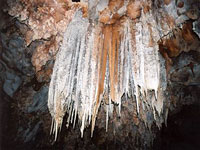
The Gran Caverna de Santo Tomás are situated about 10 miles (16km) west of Viñales. With more than 29 miles (46km) of underground galleries spanning eight different levels, it's Cuba's largest cave system and one of the most important in South America. Fantastical limestone formations, glittering stalactites and stalagmites, underground lakes and vast caverns reveal themselves by the light of headlamps. Amateur spelunkers will probably be limited to just two levels, with entrances to them semi-hidden on a forested slope overlooking the valley and providing wonderful vantage points for views and photographs.
Cueva del Indio
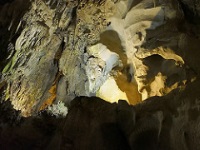
Located in the Viñales Valley, the Cueva del Indio is a magical place. In addition to the caves, the area provides some great family activities such as hiking and climbing, as well as some gorgeous rock pools for swimming in the bright green water. The caves are named for the indigenous Guanajatabey, who carved shelters into the limestone rock to hide from Spanish colonialists. Some of their bones were unearthed in the cave system and their art is still visible on the walls. Children will love the boat ride across the underground lake in the cave, and discovering the stalactites, stalagmites and petroglyphs.
Viñales Botanical Garden
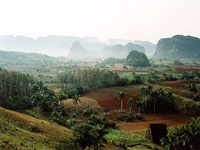
The Viñales Botanical Garden ranks highly among things to see and do in Viñales, partly because it is refreshingly intimate and unspoilt by tourists. Originally cultivated to preserve samples of indigenous tropical plants, the garden is a riot of colour and tempered jungle that delights travellers of all ages. Gardeners are available to show visitors around and teach them about all the different species of plants, which makes for a lovely, personal experience. Roosters and chickens roam freely in the sprawling garden and there are lots of lizards and birds to marvel at too. Entrance is free but small donations are expected, particularly if visitors have taken a tour.
Cuba travel info
Electricity
Most older hotels use 110 volt power, 60Hz, while newer hotels use 220 volts, 60Hz. A variety of outlets are in use, but the flat and round two-pin plugs are most common.
Language
The official language is Spanish, but English is spoken in the main tourist spots.
Money
The official currency is the Cuban Peso (CUP), which divided into 100 centavos. The Peso Convertible (CUC) functioned as a 'tourist' currency but was removed from circulation in January 2021 as part of the Cuban government's currency reform. The Cuban National Peso is the only legal cash currency in Cuba, though private hotels, bars and restaurants usually accept cash payments in dollars or euros. Sterling is not widely accepted.
Visa and MasterCard are generally accepted only in major cities and hotels as long as they haven't been issued by a US bank; Diners Club has limited acceptance, and American Express is not accepted anywhere on the island. No US-issued credit or debit cards will work in ATMs, but those holding cards issued in other countries should be able to get pesos at most major tourist destinations.
Tipping
A 10 percent tip is appreciated in restaurants and by taxi drivers.
Health
Mosquito repellant is useful as chikungunya and dengue fever do occasionally break out, even in urban areas such as Havana, and visitors are advised to take precautions against typhoid, particularly if travelling to rural areas. Medical facilities in Havana are better than elsewhere in Cuba, but visitors may need to be medically evacuated if they need specialist care. Those requiring regular prescription drugs should bring them, along with a copy of the prescription and a doctor's letter to facilitate entry through customs. Travel insurance with provision for emergency repatriation is compulsory for visitors to Cuba.
Safety
Cuba is considered comparatively free from the threat of global terrorism, but visitors are advised to be vigilant regarding crime. Theft from baggage in airports is common, and valuables should not be packed in suitcases; travellers should be wary of pickpockets and bag snatchers in Old Havana, at major tourist sites and on buses and trains. Visitors are advised to take taxis after dark rather than walk but should always make sure taxis are registered.
If there are political demonstrations of any kind, travellers should avoid them, as Cuban authorities are known to clamp down on street protests quickly and sometimes violently. Tropical storms and hurricanes usually occur between June and November. Although good warning is usually given, electricity, water and communications can be disrupted for weeks.
Local customs
Visitors should address Cuban men as 'senor' and women as 'senora'. While many Cubans will engage in political discussion and debate, it is not advisable to criticise the government too vocally and it's best to be respectful of revolutionary figures such as Fidel Castro and Che Guevara.
Homosexuality is legal in Cuba but public displays of affection between same-sex couples are not always well received by locals. The penalties for possession of illegal drugs are very strict, as are the penalties for any breach of Cuban immigration rules.
Doing business
Cubans tend to be warm and hospitable, and business is conducted more informally than in many other countries. Establishing a good relationship is vital to successful business and some time may be given over to small talk. Owing to relative isolation from the global economy, business in Cuba tends to take some time and effort, and one is often hemmed in by the country's communist practices.
Punctuality is always important, but foreigners shouldn't expect meetings to begin on time or deals to be struck quickly. The dress code tends to be more casual than elsewhere, but businesspeople still usually wear collared shirts and the dress code for women is sophisticated. Business hours are usually about 8.30am to 12.30pm and 1.30pm to 4.30pm, Monday to Friday. Some businesses are open every second Saturday.
Duty free
Travellers to Cuba who are over 18 years do not need to pay customs duty on 400 cigarettes or 50 cigars or 500g of tobacco; 3 bottles of alcoholic beverages; medicines and perfume for personal use; and gifts to the value of CUP 1,000.
Communications
The international code for Cuba is +53. WiFi availability in Cuba is expanding rapidly and hotels will often provide access, but there is still limited connectivity. A prepaid NAUTA internet card is needed and is purchasable from a ETECSA station located throughout major cities or at upscale hotels. Once visitors have a NAUTA card they'll need to find a WiFi hotspot in a modern hotel or WiFi park.
Passport & Visa
In lieu of a visa, a Tourist Card ("Tarjeta del Turista") may be issued by tour operators, travel agents, or airlines for a single-entry holiday trip of up to 30 days, provided accommodation has been pre-booked and paid. A return ticket or proof of onward travel is required, as well as sufficient funds to cover the period of intended stay in Cuba (US$50 or equivalent per person, per day). All those entering Cuba must hold travel insurance, with coverage in Cuba, to ensure cover of medical expenses for the period of stay. It is highly recommended that travellers' passports have at least six months' validity remaining after the intended date of departure from their travel destination. Immigration officials often apply different rules to those stated by travel agents and official sources.
Entry requirements
US passports must have six months' validity at the time of entry, and a visa is required. Travel to Cuba for tourist activities remains prohibited by statute.
UK passports must have an 'expiry date' at least six months after the date visitors arrive and three months after their planned departure date. Visitors will need to get a tourist card, also known as a tourist visa, before they travel. The tourist card allows visitors to stay in Cuba for up to 90 days.
Canadian passports must be valid for the duration of stay. Canadian tourists will need a visa, known as tourist card. The tourist card allows them to stay in Cuba for up to 90 days.
Australian passports must be valid for six months beyond the date of departure. Those visiting for tourism can get a tourist card, which includes a tourist visa. The tourist card allows visitors to stay in Cuba for up to 90 days.
South African passports must be valid for six months beyond the date of departure. Those visiting for tourism can get a tourist card, which includes a tourist visa. The tourist card allows visitors to stay in Cuba for up to 90 days.
Irish passports must be valid for six months beyond the date of departure. Those visiting for tourism can get a tourist card, which includes a tourist visa. The tourist card allows visitors to stay in Cuba for up to 90 days.
New Zealand passports must be valid for six months beyond the date of departure. Those visiting for tourism can get a tourist card, which includes a tourist visa. The tourist card allows visitors to stay in Cuba for up to 90 days.
Useful contacts
Official Tourism Portal, Cuba: www.cubatravel.cu
106 (police), 104 (ambulance), 105 (fire department)