

Country guides
 Europe
Renowned for its influence on Western civilisation, Greece is very much the heart of the Mediterranean experience, where travellers can escape to a heady blend of stunning vistas and warm, passionate people. Idyllic islands await those who seek blissful days of glorious sunshine and crisp waves, but there's far more on offer in this ever-popular destination. Visitors will also find iconic ruins, charming villages and some of the best nightlife in the region.
Gastronomes can feast on meze staples such as saganaki (fried haloumi cheese), kleftiko (lamb slow-baked on the bone), and souvlaki (shaved pork wrapped in a pita) and, of course, no visit is complete without a taste of Greek spirits. A trip to Greece promises unforgettable adventures and rich insight into an incredible heritage.
Best time to visit Greece
The most popular season for a visit is summer (June to August), when the weather is beautiful and sun is guaranteed. Late spring (April and May) and early autumn (late August through September) are also lovely times to holiday in Greece, as crowds are thinner and the sun is gentler.
What to see in Greece
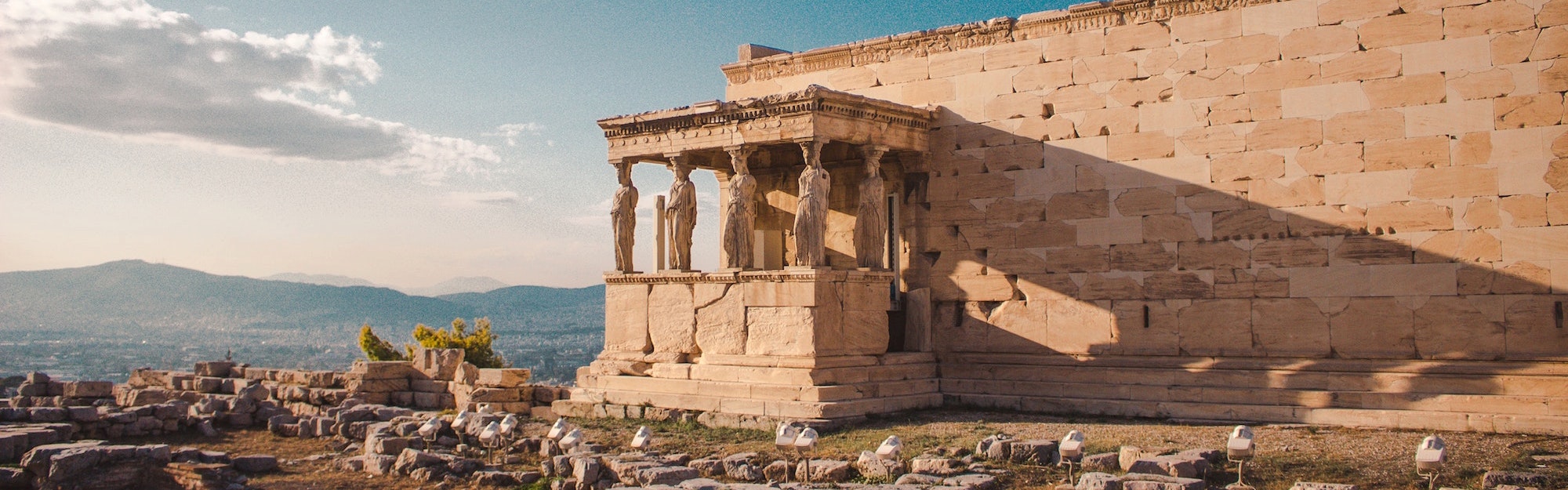
-Spend a few days marvelling at the ruins of the Parthenon and the Acropolis in Athens, and wandering through the archaeological museums nearby.
-Visit the site of the first Olympic Games in 776 BC, where there are still ruins of arenas, gymnasiums and changing rooms.
-See the tomb of King Leonidas in Sparta, along with other relics of the famous warriors of the Peloponnese Peninsula.
-Explore the Cave of the Apocalypse on Patmos, where the Apostle John is said to have written the Book of Revelation.
What to do in Greece
-Take a cruise to Crete and lounge on the beaches in Hania, Heraklion and Agios Nikolaos.
-Follow the trail of Homer's Odyssey with a visit to Ithaca, and enjoy the lively village of Vathy.
-Let loose in the trendy tavernas and nightclubs of Mykonos.
-Watch a stunning sunset off the coast of Santorini.
Holiday resorts in Greece
Greece has many popular resorts for sun-seekers looking for the perfect beach holiday. Each resort has its own character, varying from packed and lively to laid-back and secluded. Options range from single's heaven to family friendly.
Getting to Greece
There are direct cheap flights to Athens and Rhodes from many UK airports. There are direct flights to Greece from the US as well, and there are many connecting options.
Read
Zorba the Greek by Nikos Kazantzakis, The Odyssey by Homer, Captain Corelli's Mandolin by Louis de Bernières and The Magus by John Fowles.
Watch
Shirley Valentine (1989), Agora (2009), and My Life in Ruins (2009).
Drink
Ouzo
What to buy
Greek wine and products made from olive oil or olive wood. Ouzo and Metaxxa brandy. It's illegal to take historical artefacts out of Greece.
What to pack
A swimming costume for the islands, sturdy hiking shoes for the ruins, and plenty of sunblock.
What's on in Greece
Athens is the hub for Greek festivals. The Athens and Epidaurus Festival from May to October showcases the best in Greek music and culture. The Lycabettus Hill Festival hosts contemporary music and dance all summer long in the capital, and the traditional Greek Dance Festival takes place in Athens every year for a weekend in July.
Did you know?
-Greece has more archaeological museums than any other country in the world.
-More than 16 million tourists visit Greece annually, which is more than the country's whole population.
-Nearly 80 percent of Greece is mountainous.
A final word
Sunny beaches and sparkling seas combine with the rich history of a 3,000-year-old civilisation to create the ultimate holiday destination.
Things to do in Greece
Greece's fascinating history, stunning landscapes and vibrant culture are the stuff of legend and have long captivated the world's travellers. Most visitors begin their holiday in the capital, Athens, where Classical Greece is still evident through renowned structures such as the Parthenon and the Acropolis.
From Athens, many tourists head out to the islands, which provide the quintessential Greek experience. Mountainous Crete is among the most popular of them and features sparkling beaches, spectacular green outcroppings, ancient Minoan sites and the famous Samaria Gorge Trail. Corfu is loved for its mythic significance, Santorini for its stunning sunsets and unique volcanic beaches, and Rhodes for its timeless medieval town, which is a World Heritage Site. History buffs should venture to the Peloponnese Peninsula for the region's ancient ruins and battlefields.
Nature enthusiasts will relish hiking the Samaria Gorge or the trails of Mount Olympus, Greece's highest peak. For a more leisurely pace, travellers can unwind in natural hot springs or enjoy wine tours in regions such as Nemea and Santorini.
Culinary adventures abound and there are opportunities to take cooking classes, sample street food and dine in traditional tavernas. Visitors shouldn't miss local festivals for the chance to explore Greek culture through music, dance and food.
Those seeking adventure can enjoy rock climbing in Kalymnos, water sports such as diving and kayaking, or paragliding over breath-taking landscapes. Resorts such as Kalavryta and Mount Parnassus offer skiing and snowboarding, and it's worth visiting the impressive Melissani Cave in Kefalonia for a boat tour through its turquoise waters.
Greece travel info
Electricity
Electrical current is 230 volts and 50Hz. A variety of plugs are in use, including the European-style two-pin and the round three-pin.
Language
Greek is the national language, but English is widely spoken.
Money
The official currency is the euro (EUR), which is divided into 100 cents. All major credit cards are accepted and ATMs are widespread; mobile payment systems such as Google Pay and Apple Pay are supported.
Tipping
A service charge is automatically added to most restaurant bills and an additional tip is not expected, though it's always welcome. Rounding up the bill is sufficient for drinks at cafes; taxis, porters and cloakroom attendants will expect a tip.
Health
Most health problems come from too much sun and too much food or alcohol, though there's also the risk of encountering sea urchins, jellyfish and mosquitoes. Medical facilities in major cities are excellent but some of the smaller islands are a long way from a decent hospital. Larger towns and resorts have English-speaking private doctors and the highly professional local pharmacies can usually deal with any minor complaint. Travellers should take along any necessary prescription medication in the original container, which should have a prescription label. The name on the prescription must match the name on the traveller's passport. Food and water are safe, but those visiting for short periods should consider sticking to bottled water. After Brexit, the Global Health Insurance Card (GHIC) replaced the European Health Insurance Card (EHIC) for UK citizens. The GHIC allows UK citizens access to state healthcare during visits to the EU. The GHIC is not valid in Norway, Iceland, Liechtenstein or Switzerland, nor is it an alternative to travel insurance.
Safety
Though Greece is a safe destination, peak tourist season usually sees a spike in petty theft cases, especially in crowded areas. Visitors should conceal valuables or store them in hotel safes and watch out for pickpockets. Violent crime is rare but there have been incidents on some islands; visitors travelling alone should not accept lifts from strangers.
Demonstrations take place regularly, particularly in Athens around Syntagma Square, Omonia Square and Exarchia, and Thessaloniki around Aristotelous Square, Egnatia Street, the Arch of Galerius and the campus of Aristotle University. These protests draw large groups of people and often take place with little notice. They can disrupt public transport and roads; protesters and police might also clash. Sometimes petrol bombs and fireworks are thrown by protesters, and police deploy tear gas. Protests are usually held on days of social or historical significance, such as Workers' Day on 1 May, the commemoration of the Athens Polytechnic uprising of 1973 on 17 November, and the commemoration of the riots of 2008 on 6 December. Violent clashes can occur between supporters of rival football teams during which Molotov cocktails and stones have been thrown, and people have been killed. Travellers should avoid areas where demonstrations and large gatherings are taking place, follow the instructions of local authorities, and monitor local media for information on ongoing demonstrations. Transport and tour operators don't always follow safety and maintenance standards. Travellers should always check if their travel insurance policy covers the pursuit in question, ask about and insist on minimum safety requirements, and always use available safety gear, such as life jackets or seatbelts. If proper safety equipment isn't available, they should use another provider. There's a high risk of wildfires during the summer season from April to October, and visitors should be cautious if they're in or near an area affected by wildfires. If travellers find themselves in these sorts of situations, they should follow the guidance of the emergency services, or call the Greek emergency services on 112 if they're in immediate danger.
Local customs
Most Greeks are more traditional than the British in some ways, but they're also friendly and welcoming enough to seem intrusive to reserved British tourists. Greeks are the heaviest smokers in Europe and will often ignore the smoking ban in public places. Swimwear is expected on the beach but tourists should dress properly in bars and restaurants.
Doing business
Greeks prefer to dress formally in dark-coloured suits for men and stylish outfits for women. Punctuality is important to them, though meetings may not start immediately. Visitors should offer a firm handshake and maintain eye contact when greeting Greek men and women for the first time, and print business cards in both Greek and English. There's no ritual surrounding the exchange of business cards.
As Greeks like getting to know their colleagues before conducting any serious business, it's unlikely a deal will take shape at the first meeting. The local culture follows a hierarchical structure and visitors should show respect in the same way. Gift giving is common in social settings but not necessarily in business.
Duty free
Travellers visiting from inside the EU can bring in 800 cigarettes, or 200 cigars, or 400 cigarillos, or 1kg of tobacco, 10 litres of spirits with an alcohol volume over 22 percent, 20 litres of spirits with an alcohol volume under 22 percent, 90 litres of wine and 110 litres of beer.
Visitors arriving from outside the EU and are over the age of 17 will not pay duty for 200 cigarettes, or 50 cigars, or 100 cigarillos, or 250g of tobacco, 1 litres of spirits with an alcohol volume over 22 percent, 2 litres of spirits with an alcohol volume under 22 percent, 4 litres of wine and 16 litres of beer.
Communications
The international access code for Greece is +30 and the outgoing code is 00, followed by the relevant country code (e.g. 0044 for the United Kingdom). Free WiFi is available at cafes, hotels, restaurants and similar establishments throughout Greece; travellers can purchase local prepaid SIM cards for unlocked phones or use eSIMs if their cellular providers support it on their networks.
Passport & Visa
The borderless region known as the Schengen Area includes the following countries: Austria, Belgium, Czech Republic, Denmark, Estonia, Finland, France, Germany, Greece, Hungary, Iceland, Italy, Latvia, Lithuania, Luxembourg, Malta, The Netherlands, Norway, Poland, Portugal, Slovakia, Slovenia, Spain, Sweden, and Switzerland. All of these countries issue a standard Schengen visa that has a multiple entry option, and which allows the holder to travel freely within the borders of all the aforementioned countries.
Non-EEA travellers to Greece must hold visible means of financial support to cover their stay in the country. It's also recommended that non-EEA members hold return or onward tickets, and the necessary travel documentation for their next destination. Passengers not holding onward tickets may be asked for proof of sufficient funds for their return or onward journey. It's highly recommended that travellers' passports have at least six months' validity remaining after the intended date of departure from their travel destination. Immigration officials often apply different rules to those stated by travel agents and official sources.
Entry requirements
US citizens must have a passport that is valid for six months beyond the period of intended stay. No visa is required for a touristic stay of up to 90 days within a 180 day period.
UK citizens must have a passport that is valid for six months beyond the period of intended stay. No visa is required for a touristic stay of up to 90 days within a 180 day period.
Canadian citizens must have a passport that is valid for at least three months beyond the period of intended stay in Greece. No visa is required for a touristic stay of up to 90 days within a 180 day period.
Australian citizens must have a passport that is valid for at least six months beyond the period of intended stay in Greece. No visa is required for a touristic stay of up to 90 days within a 180 day period.
South African citizens must have a passport that is valid for at least three months beyond the period of intended stay, and a valid Schengen visa, to enter Greece.
Irish citizens must have a passport that is valid on arrival in Greece. No visa is required.
New Zealand citizens must have a passport that is valid for at least three months beyond the period of intended stay in Greece. No visa is required for a touristic stay of up to 90 days within a 180 day period.
Useful contacts
Greek National Tourism Organisation, Athens: www.visitgreece.gr
112 (general European emergency number); 171 (tourist police)Climate in Greece
Greece's Mediterranean climate produces long, hot, dry summers and mild, wet winters. Summer temperatures are tempered by breezes called 'Meltemia', and the Etesian wind that blows north across the Aegean Sea. Rainfall is generally low in most of the country and heaviest in the mountainous regions, where snow is likely and temperatures can get severe. Mercury on the mainland regularly hits the high spots.
Summer (between June and August) is Greece's peak holiday season and draws millions of beach lovers to its gorgeous coastline. Autumn is pleasant for travellers who prefer smaller crowds and milder conditions, while winter (December to February) sees the coldest, most variable weather and is the least popular time to visit. Travellers looking to explore Greece's cultural and historical attractions shouldn't be put off by the winter months, though.