

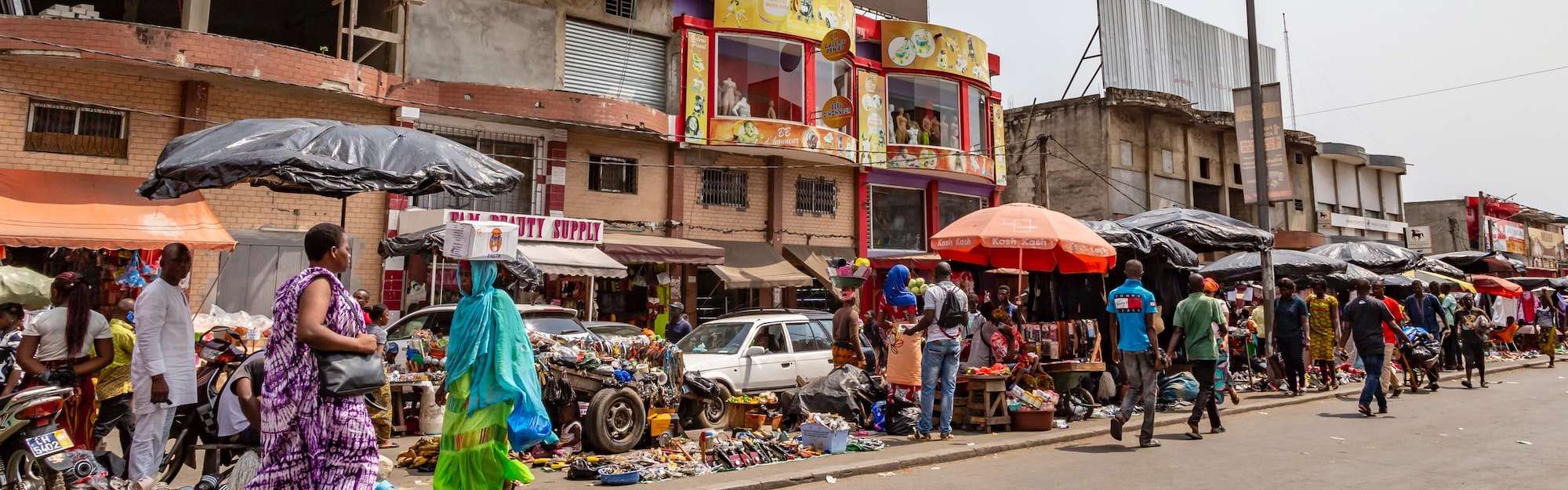

Abidjan Travel Guide
Abidjan was once the proud and flourishing capital of Côte d'Ivoire, from the 1930s until 1983, earning nicknames such as the 'Paris of West Africa'. Although the official capital moved to Yamoussoukro in 1983, Abidjan remains the country's economic and financial heart.
A standout landmark is the Hôtel Ivoire (now the Sofitel Abidjan Hôtel Ivoire), built in 1963 and expanded in the 1960s as a grand symbol of the Ivorian economic boom. It fell into decline during political and economic turmoil starting in the 1990s but underwent a major renovation between 2009 and 2015 and was brought under Sofitel/Accor management in 2013. Today, with some 423 rooms, multiple restaurants, a spa, pools, cinema and event spaces, it again embodies luxury and history.
Visitors to Abidjan can explore nearby sites such as Grand-Bassam, a coastal heritage town about 25 miles (40km) away, the rainforest reserve Parc du Banco, the National Zoological Park, and the striking modern Saint Paul's Cathedral, which was consecrated in 1985.
While French is the dominant language and English is not widely spoken, locals often speak French along with local languages such as Nouchi. The city is dynamic and business-oriented. High-end shops, supermarkets and fine restaurants are readily available, though imported goods and luxury services can be costly. Most travellers feel generally safe, though petty theft and scams can occur in crowded areas or at night, especially in certain neighbourhoods.